







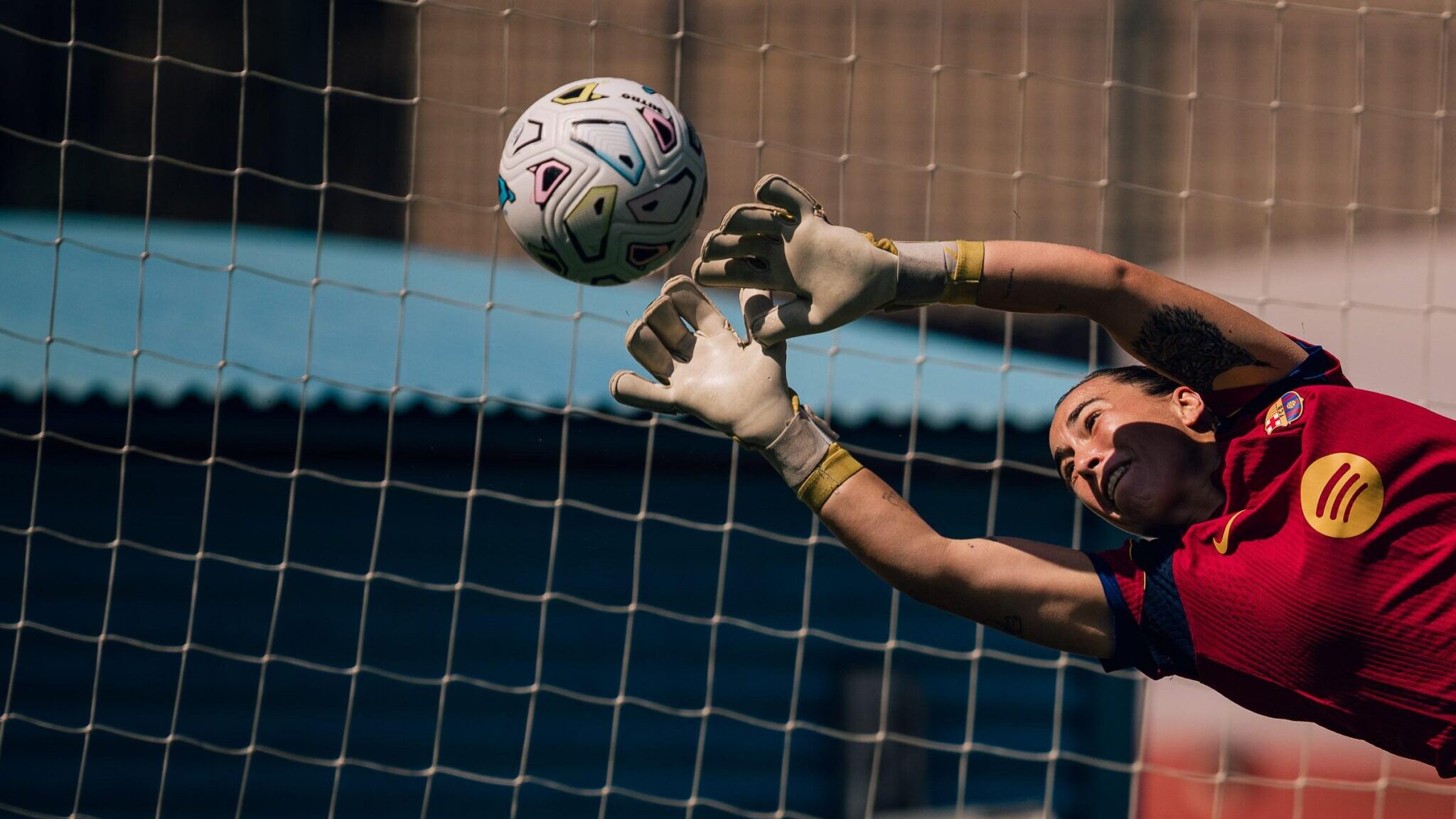
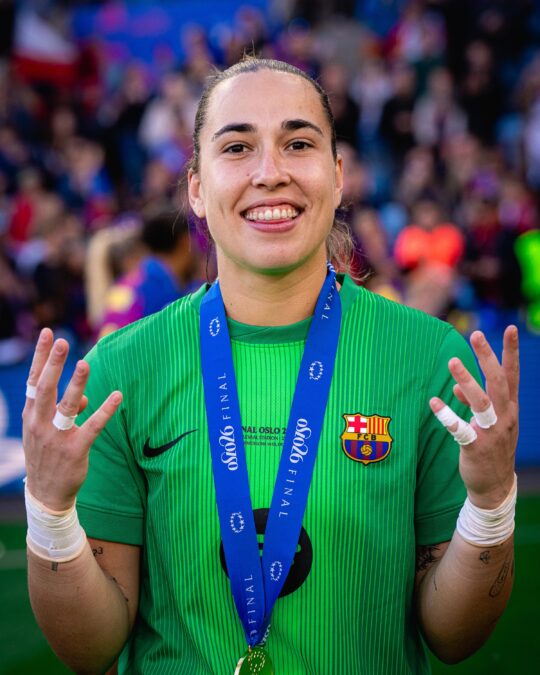
At FC Barcelona, the goalkeeping position is very well covered by Catalina Tomàs Coll (Pórtol, Mallorca, 2001), known as Cata Coll. Despite her youth, she has made the most of her time and opportunities. The most important milestone of her career was her loan to Sevilla FC in the summer of 2019, where she quickly established herself between the posts, which earned her a return to Barça the following year; since then, she has become one of the key figures in the successes of both the club and the national team. His trophy case includes a FIFA Women’s World Cup, four Champions League titles, six La Liga titles, and five Copa de la Reina.
Bold and competitive by nature, the Barça player stands out for her leadership on the field and her excellent footwork – the very DNA that the club’s goalkeepers must possess. The winner of the Golden Glove at the U-17 World Cup in Uruguay greets us on a rainy day at the Johan Cruyff Training Center, once training has finished.
How did you choose soccer as your sport?
I’ve always been pretty restless, and my parents signed me up for basketball, although I quit after two months because I didn’t like it. Then I tried tennis and played until I was fifteen, but since my best friend played soccer and I always wanted to be with him, I started training with his dad, who was the local team’s coach.
In soccer, everyone wants to be a forward or a midfielder, but very few want to be goalkeepers – why did you choose this position?
Well, I don’t know. I played center back; I was one of those players who distributed the ball and made tackles, but at training I played in goal because I was drawn to it. When I told my dad one day, he asked me not to be a goalkeeper because I’d suffer a lot, but I decided to go ahead and I think it was the right decision.
How did you end up at Barça, and what were those first years like?
I signed with FC Barcelona in 2019 and was loaned to Sevilla for a year. After a good season, I returned to Barça and started, little by little, to settle in the city and at the club. It wasn’t easy, but I was lucky to have teammates join who helped me a lot with everything, and even off the field, I never felt alone. They made everything easier for me.
Who was the first player to make you feel comfortable in the locker room?
I already knew many of the players on the youth teams, like Patri and Mariona, because they’re from Mallorca. I remember that Leila Ouahabi and Laia Codina were there too; I got along really well with them because we formed a great group.
Which Barça coach has understood you best?
Wow, that’s complicated, because the three I’ve had are very different, but I’d say Pere Romeu, the current coach, really understands me; he knows what I need at every moment, knows me very well as a person, and it’s as if he were my father or my older brother, because he knows me both on and off the field.
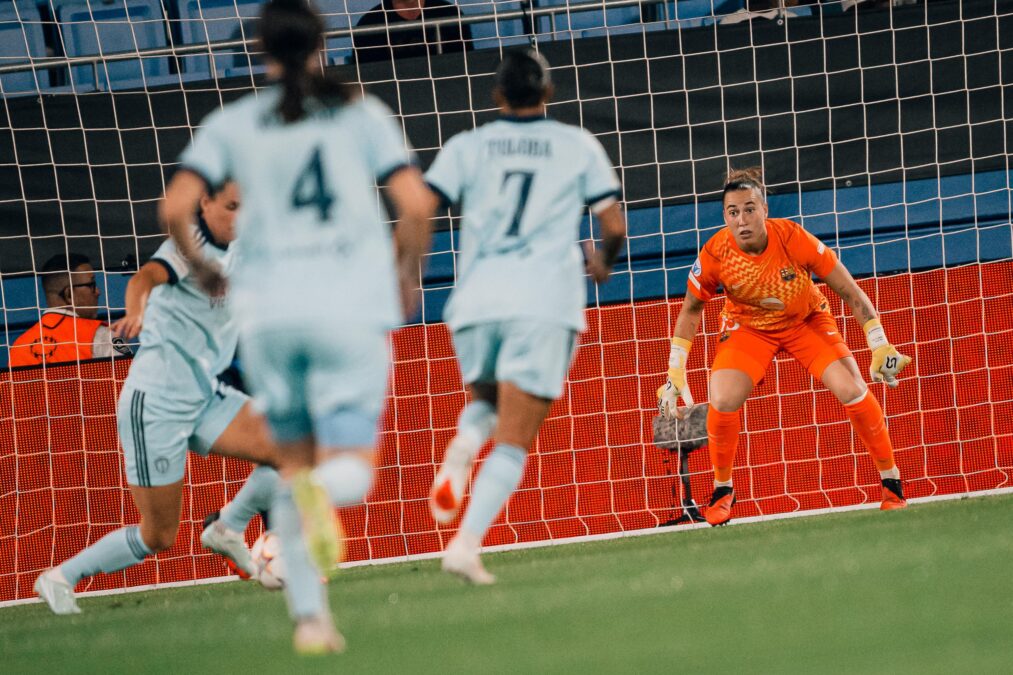
Every season we see an even better Cata. How far can you go?
My limits are set only by my body until it says “enough.” I always want to learn; I want to be the best at everything because I’m a born competitor. That makes me want more and more every day.
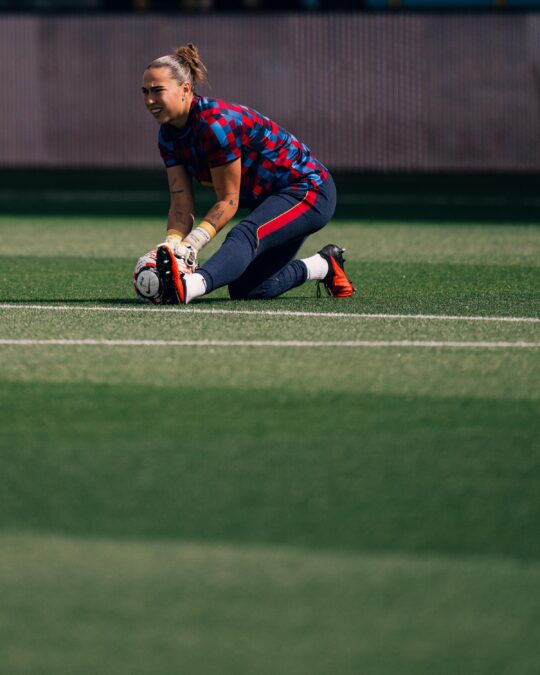
One of your greatest strengths is your footwork – the pure essence of what a Barça goalkeeper should be. How do you train it?
Well, after all, we train a lot with the players. They have us do possession drills and rondos with them, and they do everything at an incredible pace, so you either keep up or you’re out of the game. We also practice individual technique a lot, which, as you say, is in Barça’s DNA, but above all I get involved in the positional drills or anything else we do with the whole group.
This season, key players like Alexia, Mapi, and Salma have left, but the team remains just as competitive and still wins. What are the keys to its success?
Our winning mentality and our ambition. We know that everyone who comes here is familiar with this mentality, and we make sure they know it. Obviously, the soccer we play is very attractive, but if you don’t come with a willingness to learn, a desire to give your all, and the determination to be the best, you won’t have a place on the team.
Do you have any advice that has been especially useful to you and that you now try to pass on to new recruits?
Above all, I hope they have fun and just be themselves. Even if you arrive at Barça and think, “Wow, this is Barça!”, if you’re here it’s because you’re really good enough and they want you here, so you just have to be yourself and enjoy your game.
Normally you play your matches at the Johan Cruyff Sports City in front of 6,000 fans, but when you have a big game you go to Camp Nou, in front of more than 50,000 people. Does playing these matches at Camp Nou give you a special boost?
One hundred percent. I love it when I can’t hear myself talk among my teammates because it means there are people in the stadium. It’s a different feeling, and something tells you the game is going to go well because you’re motivated and excited. When I shout to the defense and they don’t hear me, I know it’s because of the pressure and the atmosphere, and that drives us to make sure the game goes our way.
Are you very demanding when it comes to defense?
Yes, a bit. I think they respect me, although the young women who are arriving now don’t so much.
You have won La Liga F for seven consecutive years. What do you think the football association should do to make it more competitive?
Investing money, right? I think it’s difficult, but we have the example of the English league, which is doing it very well, and we should adopt that model here, because I’m the first to be bothered to see how Spanish talent has to go abroad.
Barça is a club that attracts a lot of media attention, and everything it does has a major international impact. How do you handle that pressure?
Okay. I think we’re well aware of the team we’re on and what we’ve been winning. It’s also true that we’re a team that performs better under pressure, and we’re very used to it – to always wanting more – and since we’re winning, everyone focuses on us when we have a bad game, and they criticize us; they’re all over us. But that’s what sets us apart: our mentality and the fact that we’re able to play under any kind of pressure.
You’ve won everything in soccer. What about soccer still excites you?
I myself, and the desire to always be better. Sometimes it’s really hard to find that motivation, but I want to win as much as possible—and the more, the better, even if it sounds a bit greedy. We know how soccer is: you can’t always win; but above all, what keeps me going every day is feeling that I’m improving and growing as a soccer player and as a person.
You are the reigning Champions League champions and have started the season by convincingly winning your opening matches. How do you see this season unfolding, and who do you consider your main rival?
Every year it will be more difficult. What we have achieved is not easy to do. Our main rivals? Obviously, there are some very good teams, like Arsenal, Chelsea, and Olympique Lyon. That’s soccer and anyone can win, and we will do everything possible to retain the title.
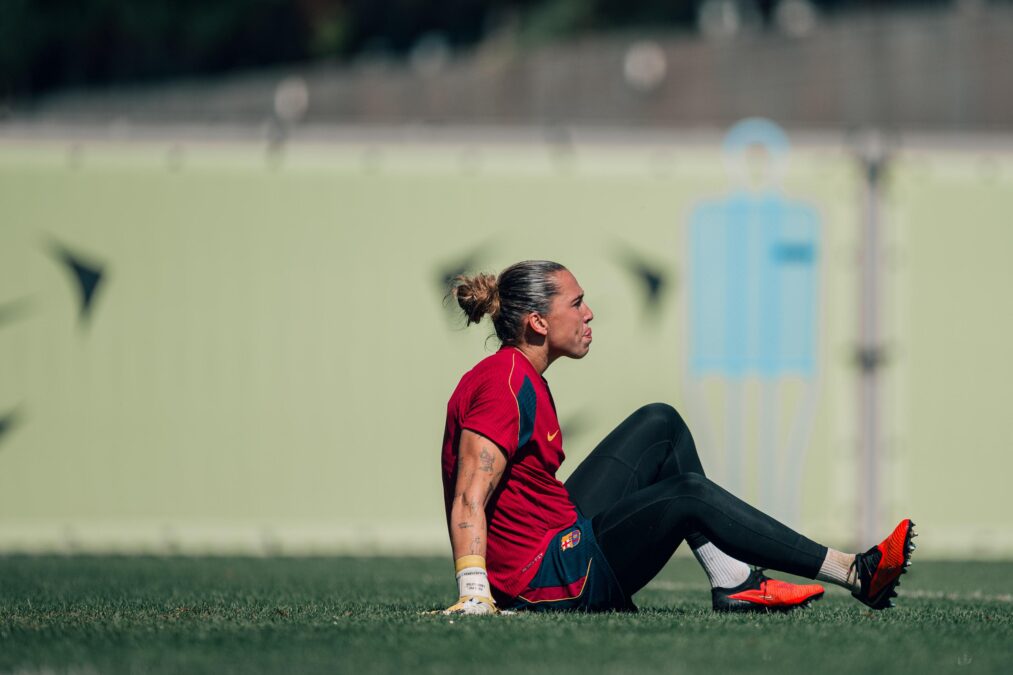
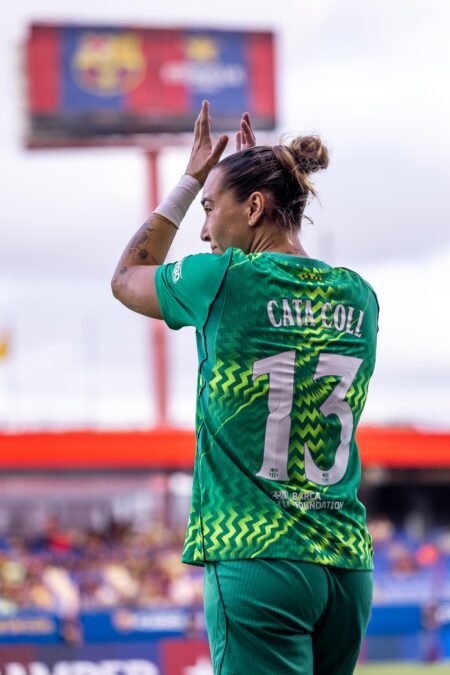
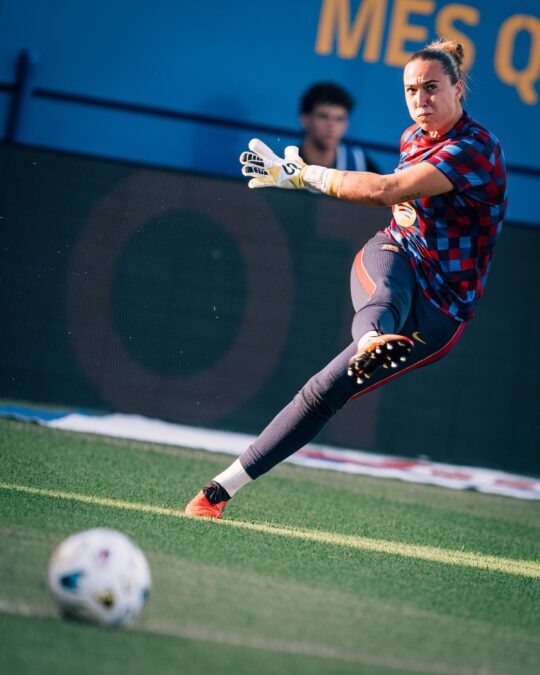
You’ve won the World Cup and the Nations League with the national team. Do you feel like you’re the team to beat?
We used to think the top teams were out of our league and we had doubts, but now we’re on equal footing with them. We know what kind of team we are and that we’ve beaten some very good teams, but we’re under pressure to keep winning games.
All that’s left now is for you to win gold at the Olympic Games. Could this happen at the next Olympic Games in 2030?
I hope so. Especially in Los Angeles. I’m still a bit disappointed by the last Olympics, so I’m really looking forward to the next ones to make up for it a bit.
The Ballon d’Or ceremony takes place in London on October 26. Who is your favorite?
My three favorites are Alexia, Ewa Pajor, and Patri Guijarro, and since she’s from Mallorca, I naturally support her. I hope Patri wins it, because I think she’s the most overlooked player in soccer; I don’t know anyone as good as her, and I believe she deserves it.
When you win an important title, how do you celebrate?
We give it our all (heh, heh). We’re a team that really loves to celebrate. Think about it: in the locker room there are many different generations, people of all ages, and we’re always celebrating, especially if we have a party the next day or a holiday is coming up.
You’re from Pórtol, a small, charming village in Mallorca. What do you miss most about the island now that you’re in Barcelona?
My people. In my hometown, I’m always just Cata—the girl who used to play there. They treat me like one of the locals, and I can sit quietly at the bar drinking a beer without anyone asking for a photo, because they respect me as another townsperson. And I also miss sobrasada.
How often do you return to your hometown?
Whenever I can. If I have a couple of days off, or even a day and a half, I go because it’s only a half-hour flight away. Luckily, it doesn’t take long.
Do you always go to Mallorca in the summer?
I’m very loyal. In the summer, instead of going on vacation anywhere, I go back home. I really love the beaches and the people there: we have it all.
Which spots in Mallorca are your favorite places to relax?
Any hidden beach (I won’t tell you the name so no one knows where I go), where you have to walk a bit and there aren’t many people. I also often retreat to my hometown and my country house, surrounded by family and friends with whom I share some meals and beers…