







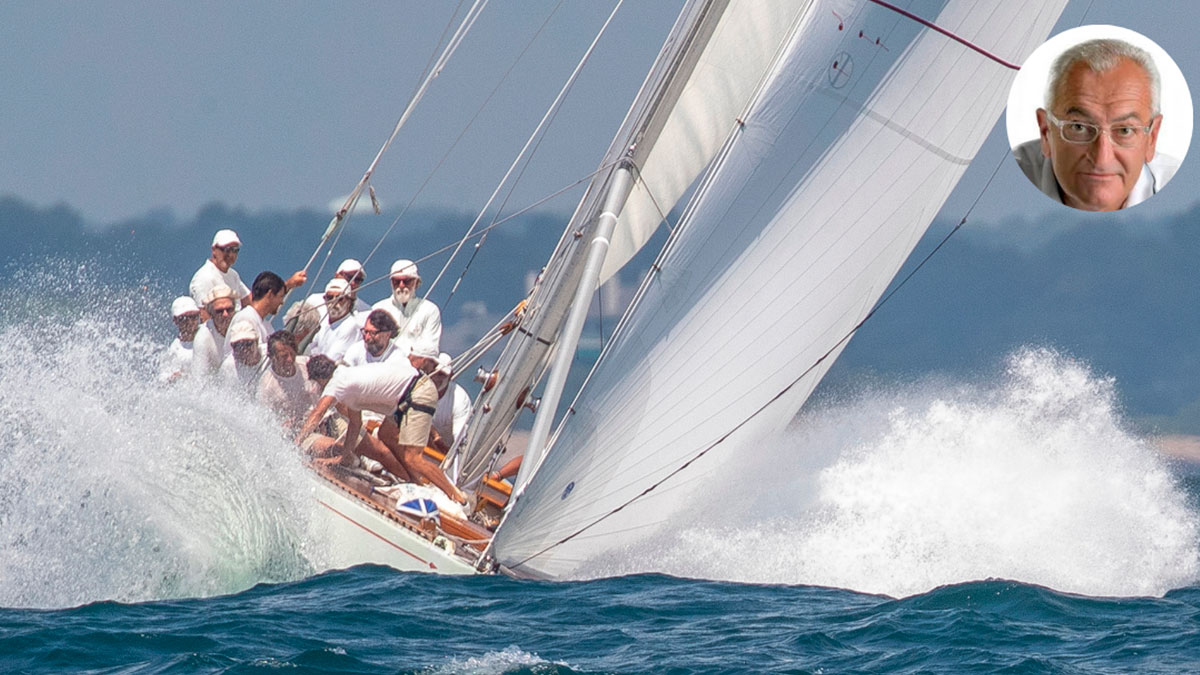
The sailing world mourns the loss of one of its greatest visual storytellers. Carlo Borlenghi, an Italian photographer whose images defined the aesthetic of the America’s Cup and offshore sailing for more than four decades, has died at the age of 70.
Born in 1956 in Bellano, on the shores of Lake Como, he leaves behind a legacy of millions of photographs that taught generations of enthusiasts to appreciate the beauty, speed, and drama of competitive sailing.
Borlenghi began his career photographing local regattas in his native Como, but it was his collaboration with *Uomo Mare Vogue* magazine that opened the doors to the international circuit for him. His first America’s Cup came in 1983, when he joined Azzurra’s pioneering challenge in Newport—the race that many consider the gateway to the modern America’s Cup. It marked the beginning of a lifelong relationship with the world’s oldest sporting trophy.
From then on, Borlenghi became a constant presence alongside the competition’s top boats: he photographed Italia in Fremantle, Il Moro di Venezia in San Diego, Luna Rossa throughout several campaigns, and Alinghi’s successful defense, and later served as the official photographer for the America’s Cup itself. Not even the pandemic prevented him from attending the 2021 edition, where he continued to document the event’s history.
His work extended far beyond the Copa América. He covered the Whitbread and Volvo Ocean Race series, the Rolex regattas around the world, Giovanni Soldini’s ocean adventures, and countless Olympic, ocean, and giant slalom events. Wherever the great sailors competed, Borlenghi was usually the first to arrive, camera in hand, waiting for the perfect moment.
What set him apart, beyond his technical brilliance, was an instinctive and profound understanding of the race itself: he knew where tension would build at the starting line, when the foam would burst at the bow, and when a helmsman’s gaze foreshadowed victory or defeat. His images conveyed movement, atmosphere, and humanity in equal measure, and he helped transform the visual language of the sport long before drones and stabilized video became commonplace.
His career was recognized with numerous awards, including the Omega Award for Best Sports Photographer and the Grand Prix de l’Image Course au Large in Paris. In 2007, the then-President of Italy, Giorgio Napolitano, honored him “for his many years of dedicated work on behalf of the world of sailing.” His exhibitions in Paris and Milan confirmed that his work belonged as much in museums as in the sailing magazines for which he worked around the world—a recognition that also reached Spain, where in 2019 the Bilbao Metro hosted a retrospective exhibition of his work as part of the SAIL In Festival.
Despite his international recognition, those who knew him highlight his approachability, his sense of humor, and his boundless enthusiasm. Younger photographers sought his advice, and sailors greeted him with almost reverential respect for his knowledge of the craft and his prodigious memory for detail.
