








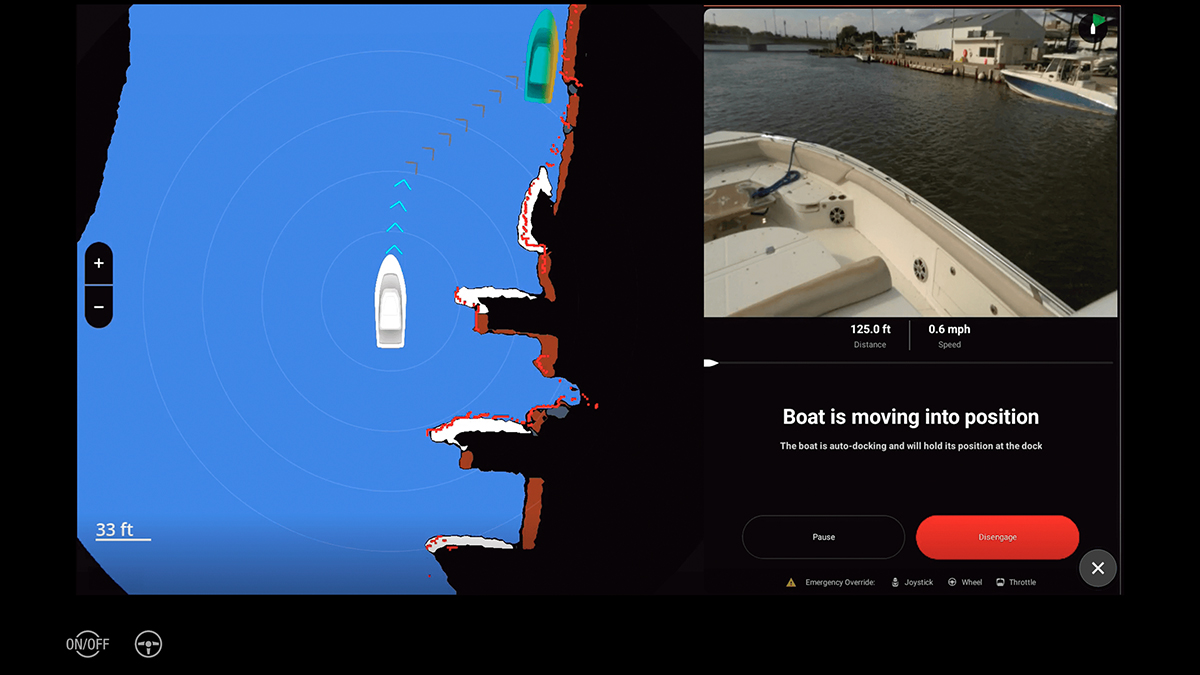
Pulling a vehicle into a parking space from a stable roadway is a piece of cake compared to successfully docking a boat, where conditions are constantly changing and the very nature of steering a vessel can make the maneuver both complicated and a bit intimidating for some recreational boaters. How nice it would be to press a few buttons and watch the boat dock or undock on its own. That’s exactly what AutoCaptain does.
Developed by Brunswick Corporation, a leader in the recreational marine industry, and marketed under its Simrad brand, AutoCaptain can dock, undock, and perform small maneuvers autonomously.
“It does this using six stereo cameras positioned around the boat that enable visualization and distance measurement, allowing it to understand its surroundings in 360 degrees, even in very low-light conditions, and that input is processed by a system that includes an NVIDIA processor,” explained Brunswick CEO Dave Foulkes in an interview. “It plots a course. It calculates how to avoid obstacles and then performs the entire close-quarters maneuver by controlling the propulsion system in a natural way.”
As is the case with an increasing number of tasks these days, artificial intelligence plays a role in how AutoCaptain works, although not in the same way that large language models operate.
Just like the AI that controls autonomous vehicles, AutoCaptain relies on what is known as computer vision, machine learning, or CVML.
“It’s a more specialized capability, and it needs to be done entirely on board,” Foulkes explained. “Ships don’t have a reliable internet connection or access to external devices or computing power. So everything has to be located on the ship itself.”
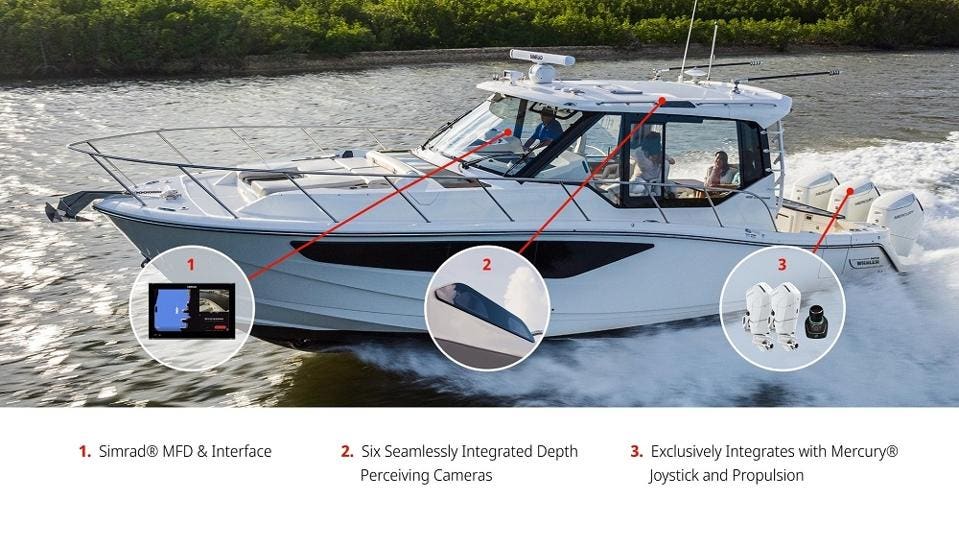
BRUNSWICK CORPORATION
What makes docking and undocking so complicated is the combination of an unstable environment and the way a ship is actually controlled. In fact, unlike drivers of land vehicles—who simply move forward, backward, and turn left or right—boat captains must also account for heave, pitch, roll, and yaw, all while constantly adjusting to the wind, waves, and current, Foulkes explained.
In addition, boats cannot turn on a dime or react immediately to acceleration or braking the way cars or trucks do. There is a latency—or delay—between the moment the throttle or helm is adjusted and the boat’s response, he added.
All of this could end up scaring off some potential boat buyers.
But both Foulkes and the head of a consumer electronics organization say that combining AI with other technologies is allaying those concerns, making sailing easier and less intimidating for both experienced sailors and beginners.
Although autonomous docking and undocking are AutoCaptain’s immediate mission, Brunswick plans to greatly expand its capabilities to perform autopilot functions in open waters—similar to collision detection and blind-spot warnings in a road vehicle—according to Foulkes.
Beyond the recreational marine sector, Kinsey Fabrizio, CEO of the Consumer Technology Association, sees the same technology—particularly the physical AI used in AutoCaptain—simplifying many other tasks.
“We have seen physical AI emerge in robotics, autonomous mobility, smart home devices, healthcare technology, and industrial applications,” Fabrizio said in an email interview. “What’s striking is that these systems are increasingly capable of understanding their environment, adapting to changing conditions, and performing increasingly complex tasks.”
Fabrizio predicts that these applications will expand into what he described as home robotics, assistive technologies that support the aging population, accessibility, autonomous mobility, smart infrastructure, and AI-powered devices capable of proactively assisting consumers in their daily lives.
Foulkes, from Brunswick, points out that the convenience of technology does not eliminate the need for training and safe operation, and that, ultimately, “it’s about feeling safe and relaxed, about feeling in control.”