







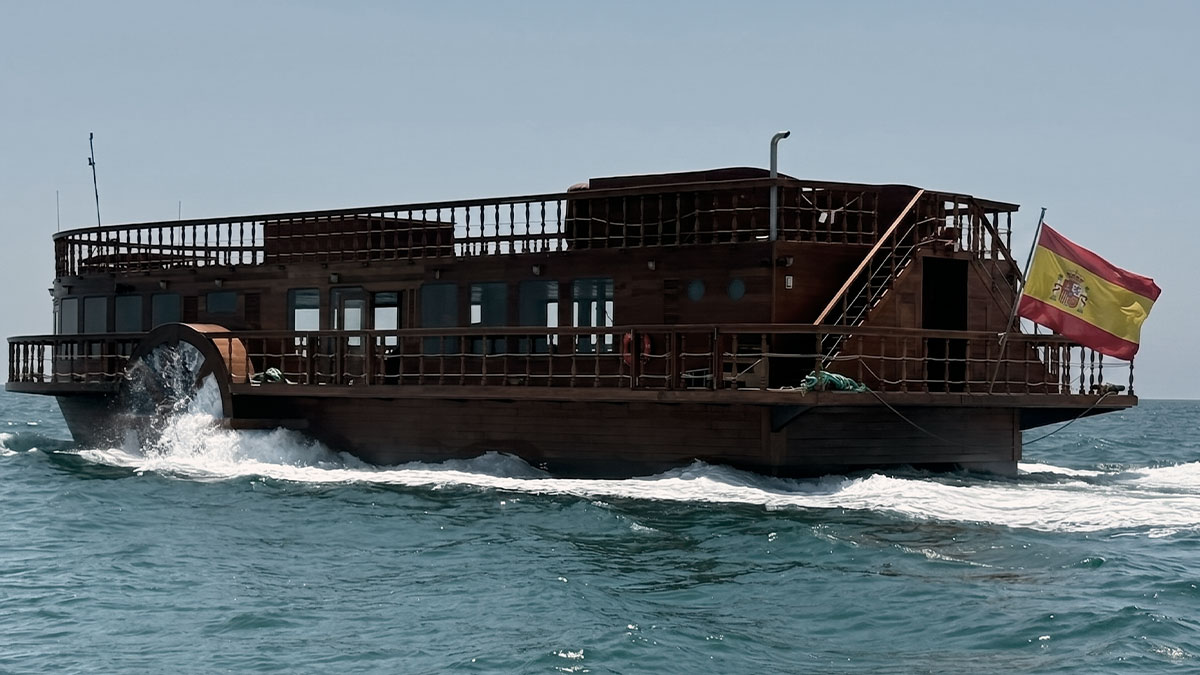
The Guadalquivir River once again welcomes the Real Fernando, a replica of the first steamship built in Spain, launched by the Nao Victoria Foundation after more than 30 months of work. The new vessel, designed as an electric and sustainable version of the original ship, revives one of the milestones in the history of Spanish navigation with a design adapted to today’s technologies.
The original Real Fernando was launched on May 30, 1817, at the Los Remedios shipyard in Triana, commissioned by the Royal Guadalquivir Navigation Company. Just a few weeks later, on July 17 of that same year, it inaugurated the first regular passenger route between Seville, Sanlúcar de Barrameda, and Cádiz, placing the Andalusian capital and its port at the forefront of the shipping industry. Among its passengers were notable figures such as Washington Irving and Benito Pérez Galdós, who immortalized the ship in his *Episodios Nacionales*.
The reconstruction of the ship required a process of historical research led by Ignacio Fernández Vial, the project’s author, which made it possible to accurately recreate the original vessel’s shape and construction details. Subsequently, the naval engineering was carried out by GHENOVA, which was responsible for transforming that documentation into three-dimensional designs and blueprints that defined the ship’s final structure.
The vessel was built in Punta Umbría by the Nao Victoria Foundation using a technique that combines a high-strength fiberglass hull with a wooden cladding on the structure and decks.
Unlike the coal-powered ship from 1817, the new version features a 100% electric propulsion system, allowing for silent navigation with no direct emissions. However, it retains the distinctive side paddle wheels that characterized the original vessel and preserve its historic appearance.
The vessel has a maximum length of 32 meters, a beam of 10.6 meters, and a draft of 1.3 meters. It has a usable area of 600 square meters spread over two decks and a capacity for 150 passengers.
After several months of testing at various ports in the province of Huelva, the Real Fernando is now ready to begin operating as a floating museum and a venue for events, conferences, and river cruises.
The project has received support from the Institute for Energy Diversification and Conservation (IDAE) through the MOVES Singular Projects II program, as well as collaboration from the Seville City Council and the Seville Port Authority. The companies FINANZAUTO, VULKAN, and FECO have also participated in the technological development, providing various propulsion systems and engineering for the vessel.