







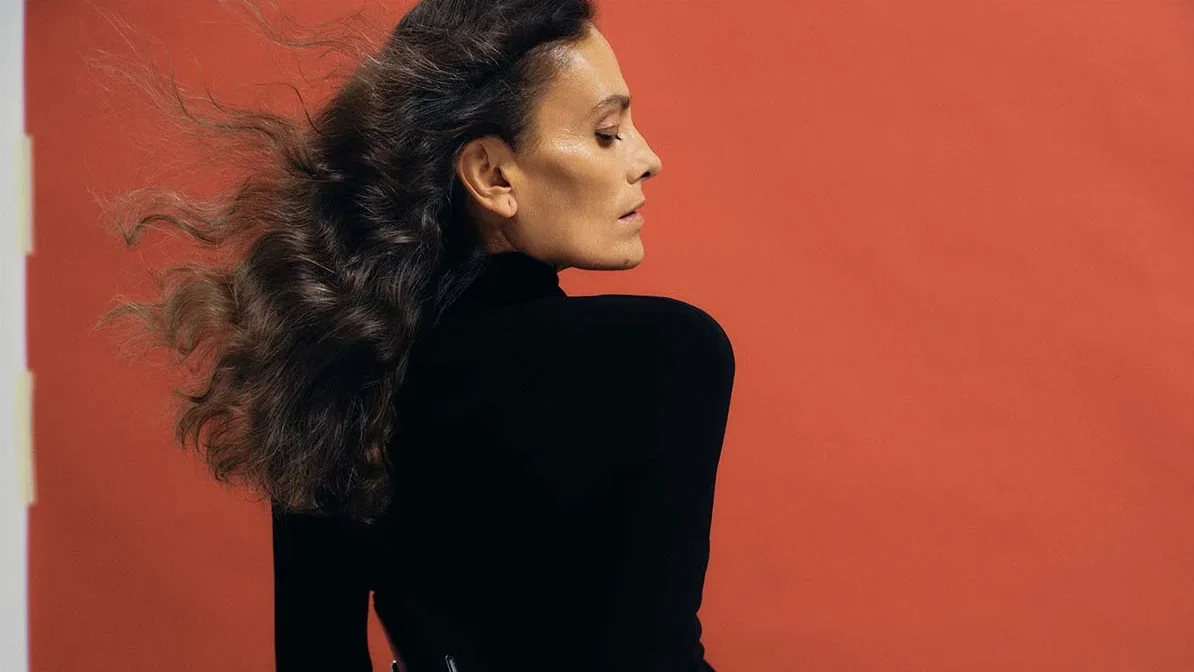
Laura Ponte (Vigo, 1973) is a renowned model who has worked with prestigious international fashion houses for decades. She is passionate about Ibiza and its fashion scene, and has just been the guest of honor at the 55th edition of the Adlib Ibiza Fashion Show.
What does Adlib mean to you?
It’s about openness, transparency, and identity. Adlib’s white is a color that is both very powerful and respectful, because there is a harmony between the garment and the person wearing it. The island itself has a constant flow of people coming and going and a mix of cultures, all of which makes Adlib a benchmark, as it is one of the few fashion brands that is truly Spanish. There are others that are specific initiatives seeking to highlight local craftsmanship and the local perspective by tracing the origins of fashion, but they do not have the same relevance as Adlib fashion.
Have you ever participated in an Adlib event before?
I’ve been to the island many times for work, but I don’t remember ever taking part in Adlib. I’ve done many photo shoots for foreign magazines on the island, and I’ve been to bachelorette parties, weddings, and other events. I love the feeling of freedom you experience there.
Adlib is celebrating its 55th anniversary this year as a fashion runway. How would you explain its history and why it remains relevant today?
Given my age, I practically grew up in the Adlib fashion movement. The fact that it has withstood the test of time and has endured for more than five decades is remarkable and says a lot about the importance of this fashion movement. In Spain, we are always tempted to look for inspiration beyond our own borders, and the fact that this fashion style originates from a place that is, in theory, so limited, yet has such a significant impact abroad, makes it unique.
In a world as highly structured as the fashion industry, can this phenomenon be understood?
Staying relevant in the fashion world is very difficult, and reaching 55 years old is almost unthinkable. I suppose that at Adlib it all comes together: the love for the land, the craftsmanship, something you want to preserve and safeguard so that future generations can discover it. And at the same time, it embodies the very spirit of Ibiza, which compels those in charge to care for and love it.
Does what you knew about this trend match your current experience as a godmother?
In certain respects, it has surprised me. In fashion, we always introduce new ideas and look for inspiration in other trends and in constant evolution. What is interesting about Adlib is that it is open to different ideas for both men and women, united by a color palette, a particular artisanal style, and the use of natural materials. Opting for traditional looms and natural, organic fabrics is risky but very bold.
In a context as technological, sophisticated, and complex as today’s, will artificial intelligence change the parameters, the way fashion is used, and the industry itself?
We must not forget the power of the individual in the face of technology, even though it seems we live in a society where someone else makes the decisions for us. I believe artificial intelligence is a fantastic tool, like all those we have discovered throughout the centuries, but it can be dangerous depending on how it is used and who is in control of it. I think having the freedom to use it is extraordinary, as long as it’s ultimately a human being who finalizes the content. It’s like the internet, email, or any other tool we now use daily.
What role do emotion and improvisation play?
Currently, we don’t know how far AI understanding and development could go; however, we know it’s a valuable yet dangerous tool, and that there are responses and parameters that seem to demonstrate a certain degree of consciousness.
Is the way models work changing?
In the world of fashion and modeling, image rights are now being sold, which allows you to earn money without having to go to the set, since an AI photo shoot can be done. Everyone, according to their individual power and responsibility and by virtue of living in a community, must recognize both its appeal and its dangers.
Why do you like Ibiza so much?
I’m a very open-minded person and I like to welcome people, and Ibiza is precisely that. A place doesn’t lose its essence simply because it opens its borders to immigration; it’s enriching, and part of Adlib’s strength lies in this interaction of cultures and perspectives from people who have settled there and have stories to tell. It’s something to keep in mind because it’s part of our cultural heritage and everything that has happened over the centuries. A mix is always a good thing.
Can the current fashion scene be compared to any other era?
In fashion, everything has already been done; now the focus is on researching new fabrics and recycled materials to curb the enormous volume of clothing currently being consumed. Plastics and polyester open up new possibilities for finding fabrics that are more pleasant against the skin and don’t harm it, even for hospital wear. The future lies in combining different styles: a 17th-century sleeve cuff is now paired with pants cut in a 1970s style. There’s a mix of inspiration and technology applied to what already exists, although there will always be something unique about the craftsmanship: like a slightly longer end of a crochet stitch, a button in a different place, or a dart. When clothes were sewn at home, people left their mark on them, confirming that it’s the human element behind it all that authenticates any change, no matter how small.
Is Spain doing well?
We should ‘reboot’ the human brain so that people would feel a greater need for accurate information, question things, and seek the truth. I would organize a global referendum to choose between war and peace. I believe that human beings are good by nature, and I’m convinced of it despite the global absurdities that are committed and despite the fact that the world is easier to control when it is divided. Divide and conquer. We are very concerned about other trends emerging around the world, but we know very little about the culture on our own doorstep.
