








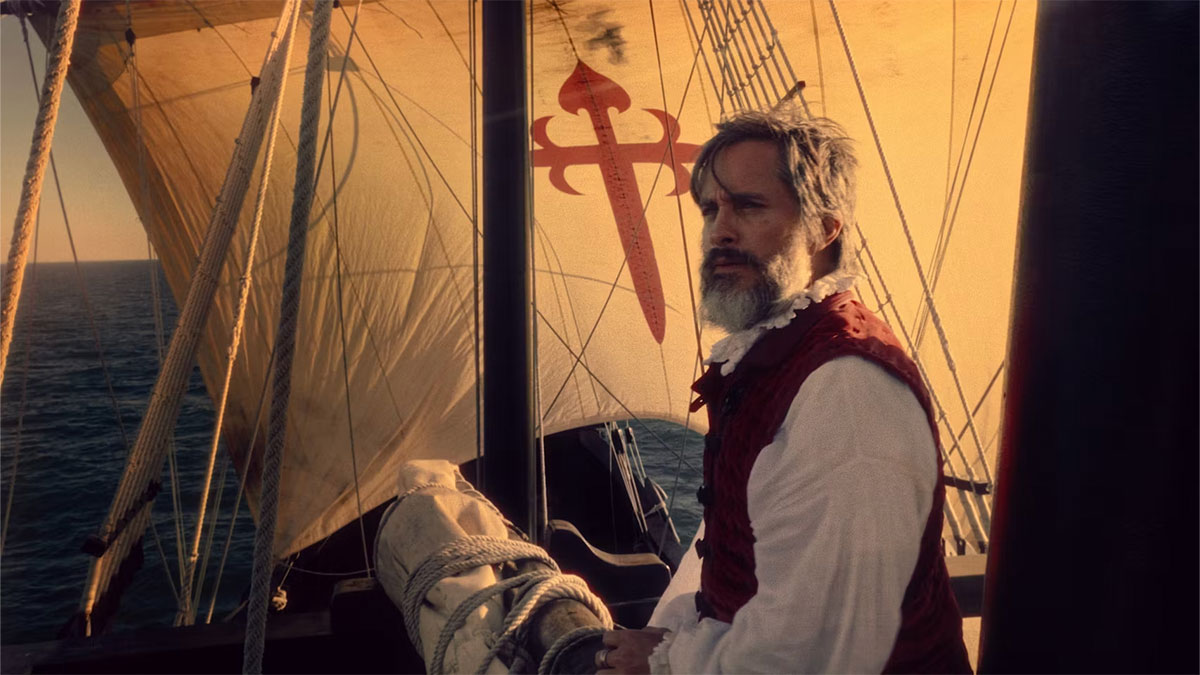
Is Gael García Bernal the most interesting actor of his generation? The answer is a resounding yes. As he is about to receive the Masters of Cinema award at the upcoming Atlàntida Mallorca Film Fest, it’s worth recalling why he is—possibly, and with all due respect to María Félix—the biggest global star that Mexican cinema has ever produced. The only person capable of speaking out against the Bush war at the Oscars back in 2003 has been demonstrating that same courage—along with immense talent, versatility, and charisma—in every role for decades. Among the Mexican star’s roles, there is no shortage of real-life figures: he played Che Guevara in the miniseries Fidel and in the film The Motorcycle Diaries, as well as the legendary professional wrestler Cassandro (the ring name of Saúl Armendáriz) in the film Cassandro.
He has now stepped into the shoes of Ferdinand Magellan in a film that offers an honest and unflinching portrayal of the beginning of the first circumnavigation of the globe. He does so in Magallanes, directed by Filipino filmmaker Lav Díaz, which opens in Spain on Friday, July 3.
In this ambitious production, which has already won the Golden Spike at the Valladolid Film Festival and was part of the official selection at Cannes, García Bernal not only plays one of the most significant (and, let’s face it, polarizing) figures in world history, but also embarks on a profound psychological and spiritual journey.
This complex immersion has earned him the recognition of the film’s director, the award-winning Lav Diaz, who has stated that “he’s on another level” and that he achieved total immersion, forging such a deep connection with the sailor that the film ended up being much more spiritual than the filmmaker himself had originally envisioned. To achieve this immersion, the film was shot in Old Portuguese and indigenous languages of the Philippines—a decision the actor himself embraced enthusiastically to give the story an authentic rhythmic and musical texture.
Hero or villain? This is how Gael sees Magallanes
As we mentioned, Magellan is a figure as monumental as he is divisive. Some see the Portuguese navigator as a visionary pioneer who connected the Atlantic and Pacific oceans and as the epitome of human resilience (the film delves into the hardships of the voyage that, in fact, cost Magellan his life, and the circumnavigation was completed by the Basque Juan Sebastián Elcano), and those who view him as a sadistic, tyrannical, bloodthirsty colonialist (whose cruelty, in fact, precipitated his death in the Philippines, where he was killed in combat against the natives).
Throughout the film’s promotional campaign, García Bernal has shared profound reflections on his character and the way we judge the past, suggesting that the Mexican character does not fall into either of these extremes. “We analyze the 16th century through 21st-century moral lenses, and that makes it impossible to understand anything,” he said in an interview with El Cultural, while, speaking to Pijama Surf, he stated that he does not believe “in the facile revisionism of telling history from our perspective. “It’s about demystifying History with a capital ‘H’ and understanding why people did what they did, what motivated their actions, and what they were facing.”
Why You Shouldn’t Miss Magallanes
Beyond García Bernal’s masterful performance, the film stands out for its effort to provide a balanced historical narrative. The story of the first circumnavigation of the globe has traditionally been told from an exclusively European and heroic perspective, based on the writings of the chronicler Antonio Pigafetta.
However, Lav Diaz’s film (which poetically revels in long shots of the ocean and the jungle) seeks to integrate the Malaysian and Filipino perspectives. The film places significant emphasis on historically silenced figures such as Enrique of Malacca, Magellan’s slave, who—having spoken the native language upon his arrival in the Philippines—could well be considered the first man to have truly circumnavigated the globe.
Furthermore, the film dares to question Filipino myths themselves. It explores the possibility that Lapulapu—the great Filipino national hero credited with killing Magallanes at the Battle of Mactan—was not a real person, but rather a collective invention to personify indigenous resistance. In the director’s vision, Magellan does not die at the hands of a single man, but rather through the collective effort of a people who refused to be forcibly converted.


