








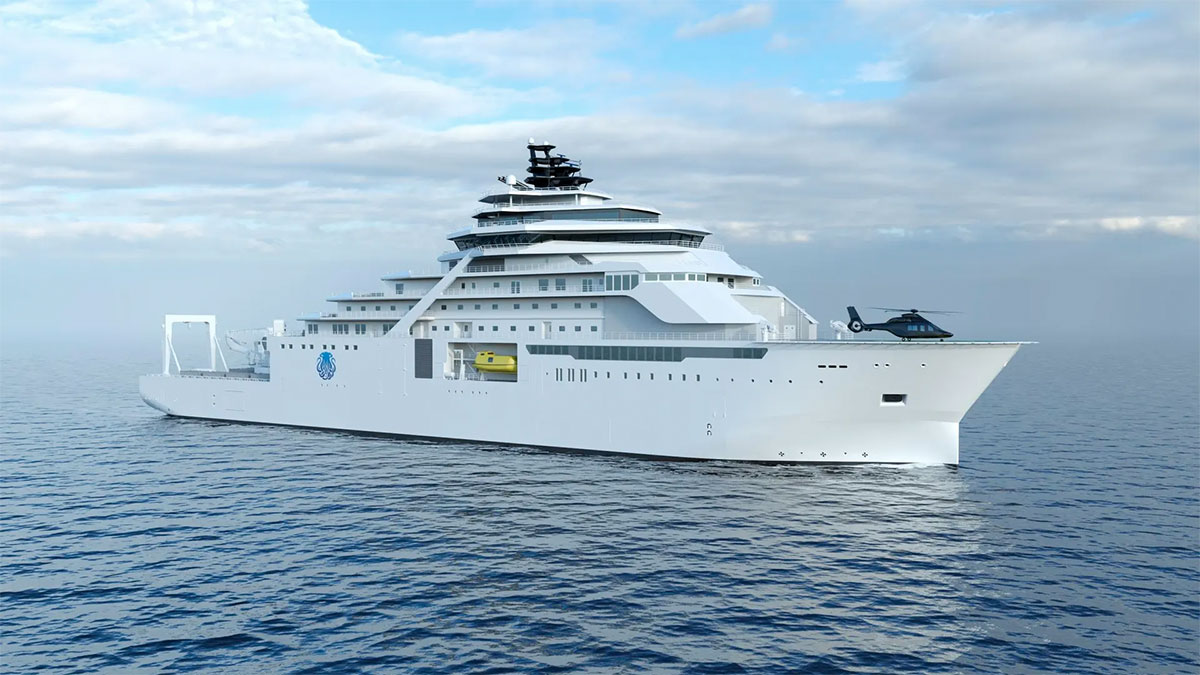
Before anyone says, “This isn’t a superyacht”… I know. But can we make an exception for Gabe Newell? The founder of Valve is a superyacht collector (Leviathan, Rocinante, Draak—all his) who recently bought the Dutch shipyard Oceanco. Besides, the REV Ocean, often cited as the world’s largest superyacht at 194.9 meters, isn’t technically a superyacht either. But that’s beside the point.
The point is that Newell is backing what could become the most capable deep-sea research vessel ever built—a €700 million project that has just become the largest single-vessel order in the history of the Norwegian shipyard Vard. Yes, that’s the Vard behind the REV Ocean.
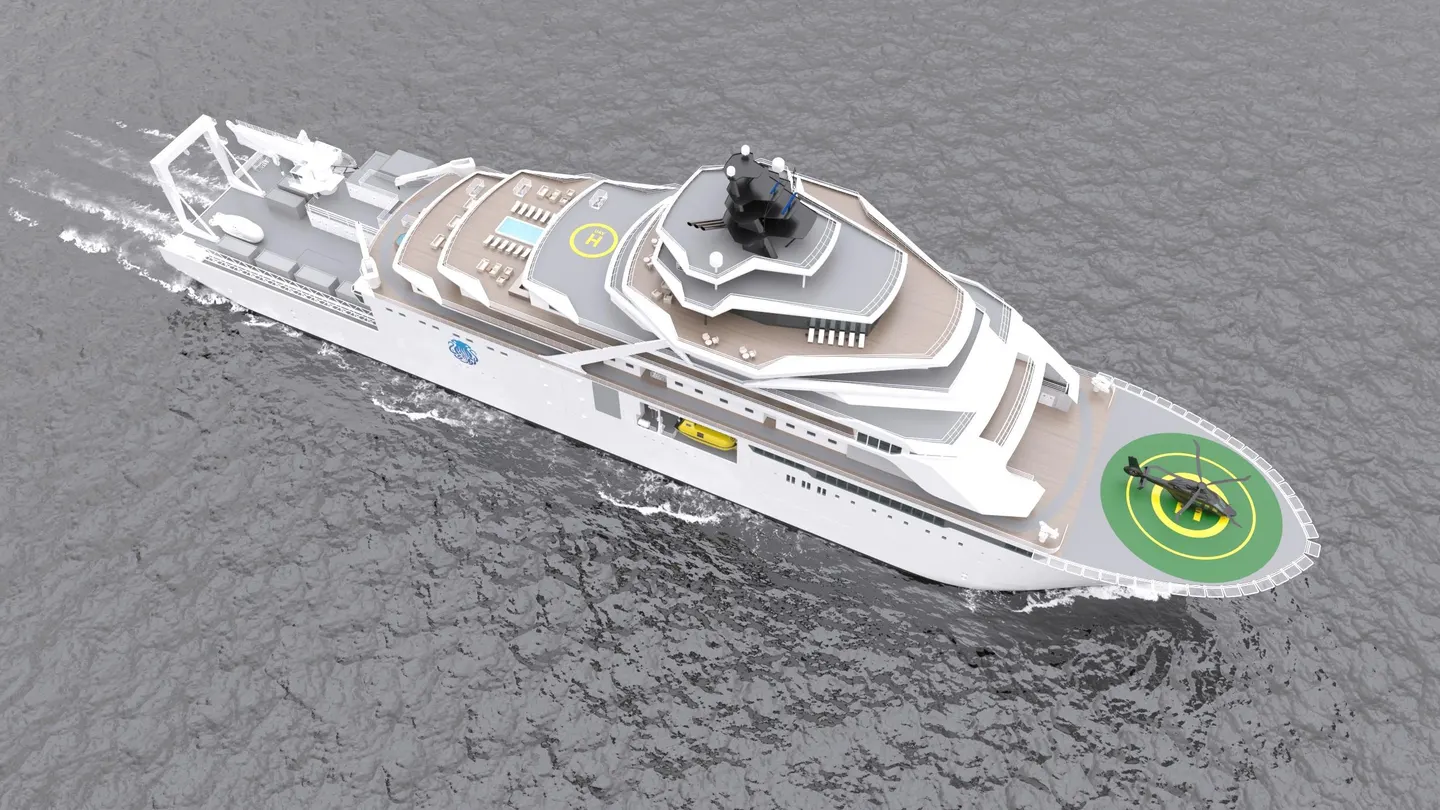
At 162 meters in length and designed to accommodate up to 130 scientists, engineers, crew members, and operators, the RV11000 resembles a floating exploration platform more than a luxury exploration yacht. Laboratories, workshops, offices, and scientific workspaces are integrated throughout the ship, enabling the RV11000 to reach and analyze nearly every corner of the world’s oceans.
The vessel is being built for Inkfish, the marine research organization founded by Newell, which has quickly become one of the world’s most ambitious privately funded ocean science initiatives.
Inkfish and the Boom in Ocean Science Funded by Billionaires
The contract, valued at nearly 700 million euros, is not only the largest order ever secured by Vard, a subsidiary of the Italian group Fincantieri, but also the largest shipbuilding contract of its kind awarded to a Norwegian shipyard.
For Vard, the project marks a milestone; for Inkfish, it is the next step in its efforts to study and better understand the least-mapped environment on Earth, as less than 30% of the world’s seafloor has been mapped to modern standards.

The RV11000 follows in the footsteps of the first research vessel built specifically for Inkfish, the RV6000, which was commissioned from Vard in 2025. The vessel has been specifically designed to operate at depths of up to 11,000 meters—deep enough to reach Challenger Deep in the Mariana Trench, the deepest known point in Earth’s oceans.
Once delivered, it will join an expanding fleet that already includes Newell’s smaller research vessels, the Hydra and the Dagon.
Designed for the deepest oceans: capable of exploring depths of 11,000 meters
To fulfill this mission, the RV11000 combines technologies that are rarely found together on a single platform. A stern-mounted launch and recovery system will enable the deployment of manned submersibles, while a dedicated hangar has capacity for two submersibles. Meanwhile, a separate ROV facility will support remotely operated vehicles capable of conducting research and exploration at extreme depths.

The vessel will also carry a 40-meter-deep sampling system to collect sediment samples from the seafloor, advanced oceanographic instrumentation, and fiber-optic cable-based hoisting systems capable of operating throughout virtually the entire water column, from the surface to the seafloor. The hull has been specifically optimized for high-precision seafloor mapping—one of the most important tools in modern oceanography—and, while not the most eye-catching feature, the RV11000 will also feature the largest battery system ever installed on a ship.
This battery system will enable up to 12 hours of silent scientific operations powered entirely by batteries, thereby reducing both emissions and underwater noise that can interfere with sensitive marine research.

Whether we like it or not, some of the greatest advances in exploration have historically depended on wealthy patrons willing to fund them. Shackleton had his benefactors (Sir James Key Caird, Llewellyn Longstaff); outer space has its billionaire patrons—Jeff Bezos, Elon Musk, and the like—and now, it seems there is a new face of ocean science.
But the organization’s stated goal is not exploration for its own sake. The data collected by Inkfish’s vessels is intended to contribute to open scientific repositories, making the findings available to researchers around the world.
So, even though it doesn’t have a beach club or a champagne deck, Gabe Newell’s latest vessel could turn out to be far more significant than your average billionaire’s superyacht. To find out, you’ll have to check out Leviathan.