








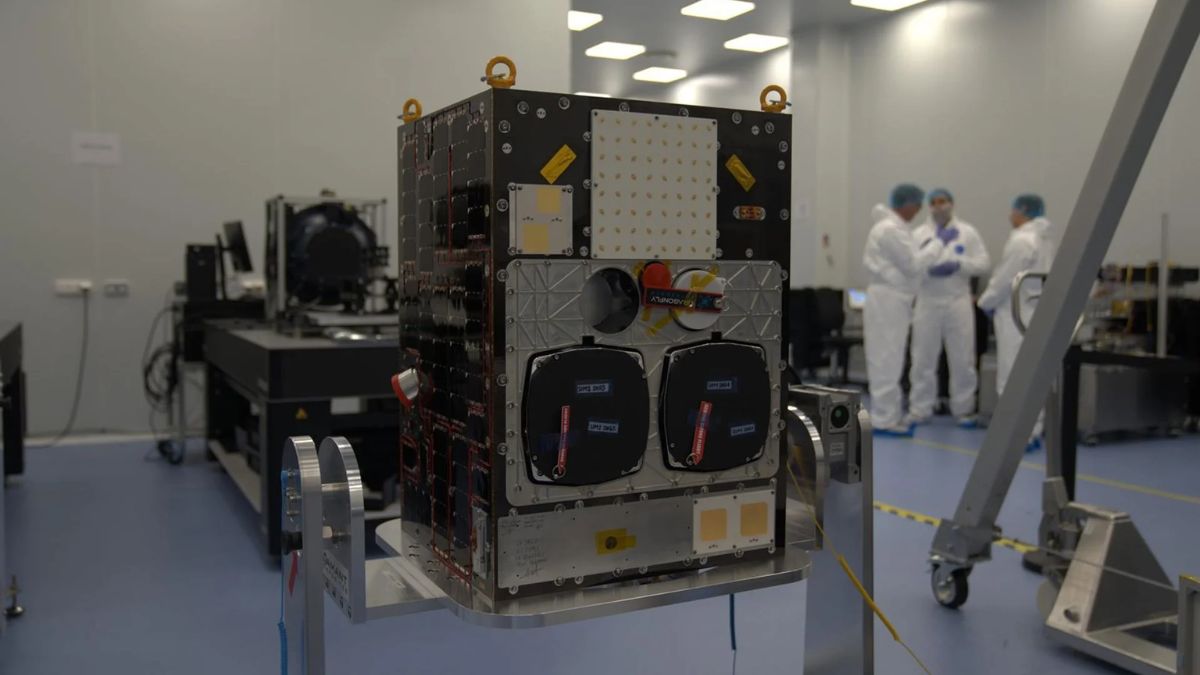
The Posidonia satellite, the first in the history of the Balearic Islands and designed to monitor climate change-related phenomena and manage natural disasters, is now fully completed and ready for launch this summer.
The Regional Minister of Economy, Finance, and Innovation, Antoni Costa, visited the facilities of Open Cosmos—the company that developed the satellite—on Thursday to see the project’s final status firsthand.
During the visit, Costa toured the company’s R&D&I areas and satellite factory, where technical staff explained the various processes involved in developing, integrating, and validating the space devices they manufacture.
Subsequently, as reported by the Regional Ministry in a press release, he entered the Clean Room—the high-security, climate-controlled facility where the Posidonia satellite is located—and signed the device’s outer structure before it is shipped for launch.
The Posidonia project, co-financed with three million euros in European funds from the regional government and three million euros in collaboration with Open Cosmos, the University of the Balearic Islands (UIB), Wireless DNA, and Garden Hotels, aims to obtain high-resolution data and images to advance the fight against climate change, territorial management, and the sustainability of tourism in the archipelago.
"The Posidonia project symbolizes the Balearic Islands’ ability to lead innovative initiatives with a real impact on the region and on the future of our economy. Public-private collaboration is allowing us to position ourselves on the international map of innovation and the aerospace sector, with a technological infrastructure that will provide key information for making strategic decisions based on scientific data," said Costa.
For his part, Open Cosmos CEO and founder Rafael Jordà stated that seeing the Posidonia satellite fully completed "is a historic milestone" and demonstrates that from the Balearic Islands "we can drive high-level international technological initiatives, generating knowledge, innovation, and new economic opportunities linked to the space sector."
The satellite will enable the monitoring of phenomena related to climate change, sea temperature, coastal evolution, human pressure on the territory, and natural disaster management, among other applications.
Additionally, it will facilitate access to strategic data for government agencies, research centers, and companies in the archipelago.