








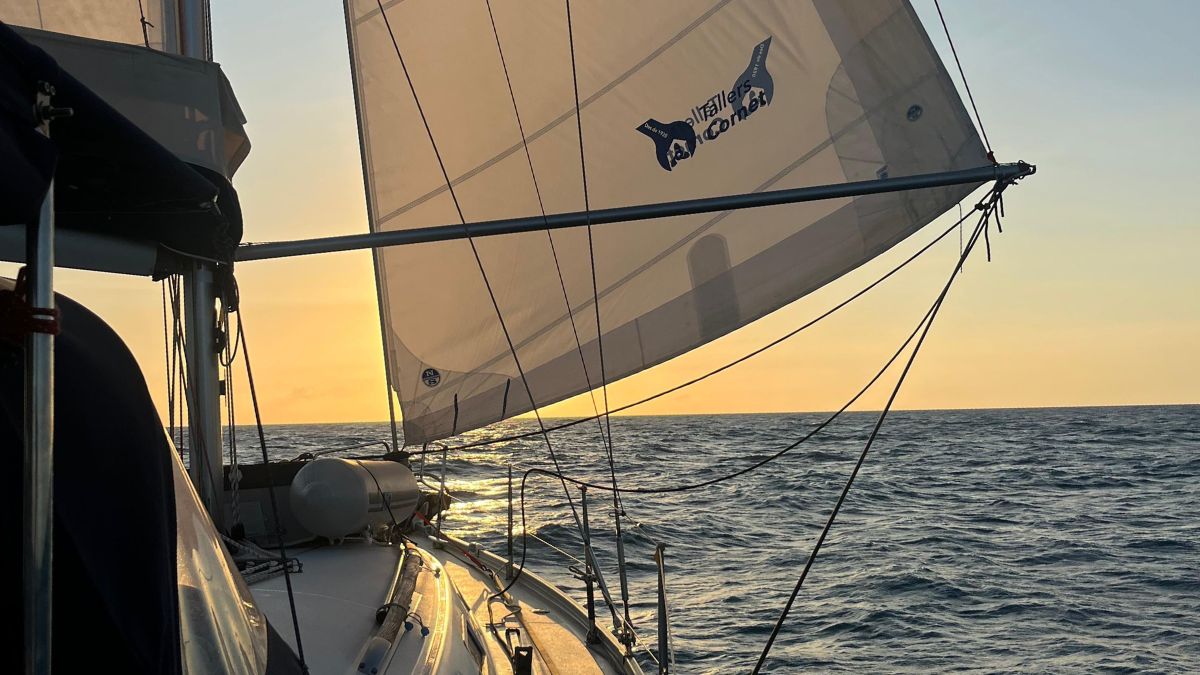
How quickly I get used to having company, and how hard it is to get back into the rhythm of solitude. Even though I sought it out, it’s tough to be alone with “Sofía” again, at least for the first few days. I’m taking this opportunity to keep my mind and body busy and let the boat sail with the tide as I set course for Bali, about 570 miles away.
Months before setting off on my round-the-world voyage, back in Spain, when I was telling my friends and family about the adventure I wanted to embark on, one of the most common questions was: “That long, all by yourself?” There hasn’t been a single moment when I’ve regretted setting sail solo. The visitors I’ve had have given me the drive to keep going and believe even more that I can do it. Sailing solo is something you have to experience to understand and feel the sensations it brings. You immerse yourself in a bubble where only the ‘Sofía,’ the ocean, and the present exist. In those moments when the wind pushes you toward your destination, the sun is shining, the sea is calm, and the sailboat is making good headway, my body and mind enter another dimension. I lose track of time, and the feeling of pure ecstasy, combined with sheer joy, gives me goosebumps. That’s when I don’t want to reach my destination.
In tough moments, when the ocean is rough, the ‘Sofía’ rocks from side to side, waves crash against the hull, spraying the deck with spray, and everything around me is in turmoil, I tell myself: we have to keep going. Every moment is part of the show. There are times when I worry more about the ‘Sofía’ than about myself. As long as she’s seaworthy, everything can be worked out, which is why I have to take good care of her all the time.
I wake up as soon as the sun peeks over the horizon. I weigh anchor and, as I leave the bay, a Spanish couple I befriended on Thursday Island—and whom I’ve run into again in Kupang—wave me off. I feel like something is missing. Sailing close to the coast is complicated by the number of fishing buoys out there. I try to sail as fast as possible to get away from the coast as quickly as I can; that way, at night there’s less chance of running into buoys that aren’t lit. It would be like playing Minesweeper.
Night falls, and with it, I return to my 20- to 30-minute sleep cycles. I wake up to check the sails, the wind, and the horizon, then go back to sleep for another 20 to 30 minutes. This goes on until dawn. During one of these sleep intervals, I have a nightmare: I’m sailing solo across the Mediterranean in a storm, with the sails reefed and at full speed. Suddenly, I see several lights on the horizon that are getting bigger and bigger, and I figure it must be land. I check the chart, and it says there’s no land within 100 miles of me. The lights are approaching rapidly, and everything points to the coast. The sailboat picks up speed, and I’m a mile from the lights, which I now confirm are the coast: the chart is wrong. Just as I’m about to crash into it, I wake up and find myself standing in the cockpit, staring at the horizon… I didn’t know if it was a dream or reality.
The first night is tough for me. My body feels tired, and every time I wake up to check that everything is okay, I have a hard time moving. The night is calm, with a moderate wind of about 15 knots, and the ‘Sofía’ sails steadily all night long. In the morning, I feel lonely; I try to keep myself busy so I don’t get lost in my thoughts. I write, read, prepare my fishing gear, eat toast with chocolate, take a nice shower, and set dinner aside so I’ll just have to heat it up later. Another quiet night. A merchant ship passes my stern, and several fishing boats remain on the port side. No need to maneuver, but I do have to stay on guard. The next day the sun is shining and spirits are high. I feel better than yesterday, and today I’m in luck: a good-sized mahi-mahi takes the bait. I haul it on deck through the stern and fillet it to prepare lunch and dinner for the day.
The fifth and final night is one of the toughest, not because of the wind and the sea, but because of the constant downpours, lightning, unlit buoys, and floating logs. The wind has dropped to 7 knots, which isn’t enough to sail. I have to start the engine. At 2 a.m., I hear a deafening noise, put the engine in neutral, and look over the stern. A log has struck the propeller and split into two pieces… I pray that everything is okay. I go down to the cabin and inspect the engine room. There’s no leak. I switch back to forward and check the shaft, which is turning normally. Every 20 minutes I go to the bow and shine a flashlight to spot any logs or buoys. All night long, in the pitch-black, moonless darkness, I’m illuminated by the intermittent flashes of lightning surrounding the ‘Sofía.’ Every now and then, a bolt strikes too close… At 4 a.m., a 150-liter metal drum, surrounded by tires, passes 5 meters to port of the ‘Sofía.’ I give thanks that we didn’t collide. I wish dawn would come already. The current in the Lombok Strait, between Bali and Lombok, is already taking effect, and we’re sailing at 3 knots. At least, if we collide with something, it will be at low speed. The night is a lottery.
Dawn is finally breaking, and I feel relieved. Visibility is good, and after a sleepless night—literally—I stay in the cockpit, my eyes fixed on the bow. Thirty miles from Bali, I’m not going to let my guard down. The current in the strait is getting stronger; it slows us down to a speed of 2 knots. Once past the strait, with rough seas and choppy waves caused by the current, it eases up and the Sofía picks up speed again to her cruising speed. The wind still isn’t blowing, but Bali is already coming into view ahead. I enter a bay south of the island where there’s a port under construction. I’ve contacted the port manager, and he’s letting me tie up to a buoy for a few days completely free of charge.
Thanks again, “Sofía,” for getting me to Bali without a hitch; you deserve a break. I tidy up the inside a bit, take a shower, call my family, have a light dinner, and collapse into my bunk.


