








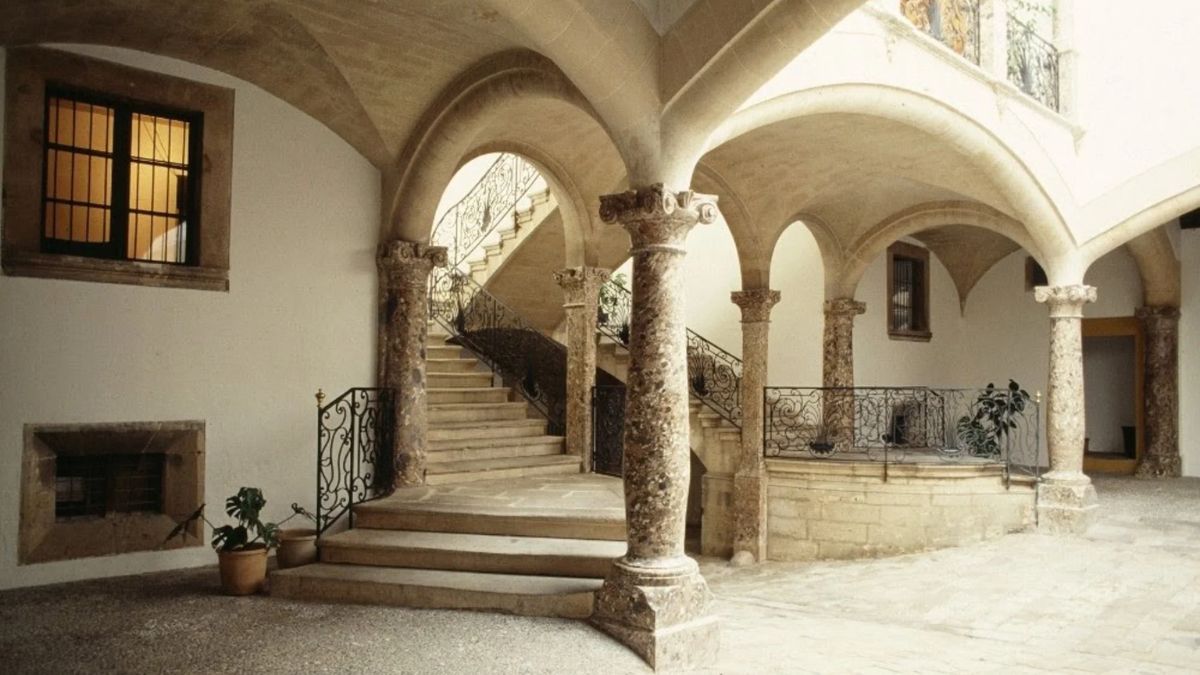
One of the largest concentrations of stately courtyards in the Mediterranean
Palma’s historic center preserves one of the largest concentrations of stately courtyards in the Mediterranean. These spaces, integrated into noble houses built between the 17th and 18th centuries, were the heart of the home: they organized access, facilitated ventilation, and structured daily life.
One of the most notable examples is Can Vivot, one of the few palaces whose interior is open to visitors. Its cobblestone courtyard opens directly from the entrance and leads to a large main staircase, designed to mark the access to the upper floors. The complex preserves original elements such as the stone floors, the interior wooden and iron balconies, and the layout around a central courtyard, which help illustrate how these residences were structured.
A few steps away, Can Oms, located next to Almudaina Street, features a more sober structure. Its courtyard, of more modest dimensions, combines stone arches and a staircase integrated into the space, reflecting a more functional architecture, where the organization of access and interior circulation takes precedence over monumentality.
On Passeig del Born, Casal Solleric offers an interesting variation. Built in the 18th century by a family of wealthy merchants, the building follows a logic distinct from that of the traditional nobility. Its courtyard is more spacious and surrounded by upper galleries supported by columns, incorporating greater visual openness and a clear desire for representativeness. Today, the building functions as a cultural center.
Also noteworthy is Casal Balaguer, one of the city’s finest examples of a restored urban stately residence. The building, of medieval origin and transformed between the 17th and 18th centuries, preserves an elegant interior courtyard with columns, arches, and a monumental staircase, where the superimposition of architectural styles is evident.
The best-preserved collection of noble architecture in Menorca
In Menorca, Ciutadella stands out for preserving one of the best-preserved ensembles of aristocratic architecture in the archipelago. Most of these palaces were built between the 17th and 19th centuries by noble families and landowners, and they still define the image of the historic center, especially around the Plaza del Born.
Unlike Palma, where courtyards are more hidden, in Ciutadella the entrances are more direct and the interior spaces are visible from the entrance.
Can Saura
is one of the most representative examples. Its large size—it occupies practically an entire city block—and its vaulted entrance lead to a spacious courtyard where the main staircase organizes the building’s layout. Today, the interior is open to visitors, allowing one to observe elements such as the original structure, the passageways, and the relationship between the courtyard and the main rooms.
In the Plaza del Born, the Palau Salort
stands out for its interior layout. The entrance hall connects directly to a monumental staircase that leads to the main halls, decorated with period features such as moldings, historic furniture, and large windows facing the plaza.
There are other buildings, such as Can Torre Saura and Can Olivar
, that share a similar style: sober facades, wrought-iron balconies, and interior courtyards that organize the space. These buildings feature recurring elements such as large doorways, spacious lobbies, and main staircases leading directly to the main floors, creating an architectural model recognizable throughout the city.