








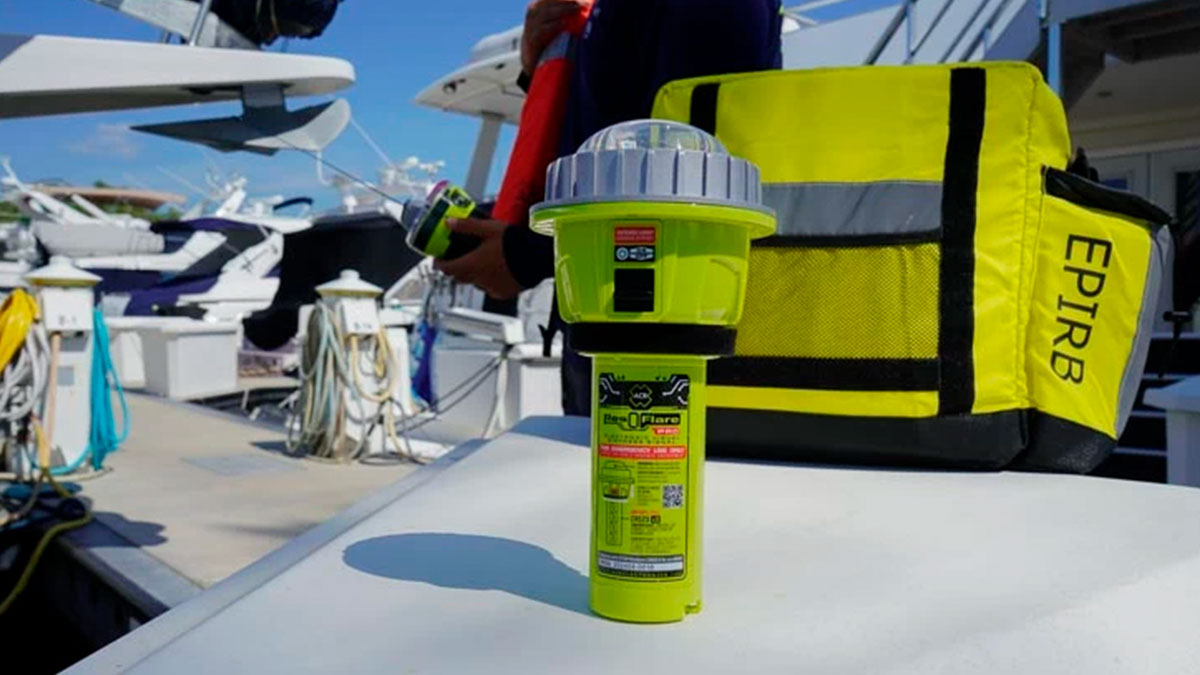
Technology is also transforming onboard safety equipment. ACR Electronics, a U.S. manufacturer of flares and survival equipment since 1956, proposes replacing traditional pyrotechnic signaling with the ResQFlare PRO, an electronic flare designed to make it easier to locate a vessel in an emergency.
Flame-less lighting: a revolution in battery life, price, and sustainability
Compact, buoyant, and waterproof (with an IP67 waterproof rating), the beacon emits red-orange and cyan LED flashes, as well as infrared signals. It transmits the international SOS distress code and has a claimed visibility of more than eight nautical miles under certain conditions. It rights itself in the water and is activated by a single slide switch.
Its main appeal is that it does not rely on combustion. Unlike conventional sparklers, it produces no flames, smoke, or chemical waste, and has no expiration date associated with a pyrotechnic charge. It only requires replacing the batteries once a year. Pyrotechnic flares, on the other hand, have a shelf life of 42 months, after which they are no longer valid and must be disposed of as hazardous waste.
The device offers up to three hours of runtime at average effective intensity, unlike pyrotechnic flares, which burn for between 30 seconds and 15 minutes depending on the type. Its listed price on the manufacturer’s website is €237.99. By contrast, a pack of three approved pyrotechnic flares costs about $40 (34 euros), and since they must be replaced every three and a half years, the cost over a decade amounts to $120 (102 euros), not including the cost of disposing of them.
Support from the Coast Guard
The U.S. Coast Guard has removed MK 124 pyrotechnic flares from its small boats and cutters in favor of electronic devices. “This clearly signals the Coast Guard’s preference,” says Mikele D’Arcangelo, vice president of Global Marketing and Product Management at ACR Electronics.
ResQFlare PRO is certified as a nighttime visual distress signal (46 CFR 161.013). It includes a distress flag to supplement daytime signaling, and the set meets the requirements for recreational vessels up to 65 feet (about 20 meters) under the conditions established by U.S. regulations. The flag is essential: the device alone does not replace pyrotechnic flares, as it is only valid as a nighttime signal.
Pending international regulations
Outside the U.S., acceptance varies: some countries allow these devices as substitutes, while others require both types to be carried on board. The SOLAS Convention has not yet established comprehensive standards for electronic alternatives. “We still need to establish an international standard that can be adopted by the IMO and other maritime agencies,” notes D’Arcangelo. As a practical recommendation, it’s best to test it once a year inside the vessel (outdoor testing is not permitted) and store it in a location that’s immediately accessible—never in deep storage compartments or in the engine room.
Where can I buy it? On the ACR website itself, for €237.99. Click this link.
Important: The ResQFlare and its included distress flag are legally accepted substitutes for USCG pyrotechnic flares (in the U.S. only).