







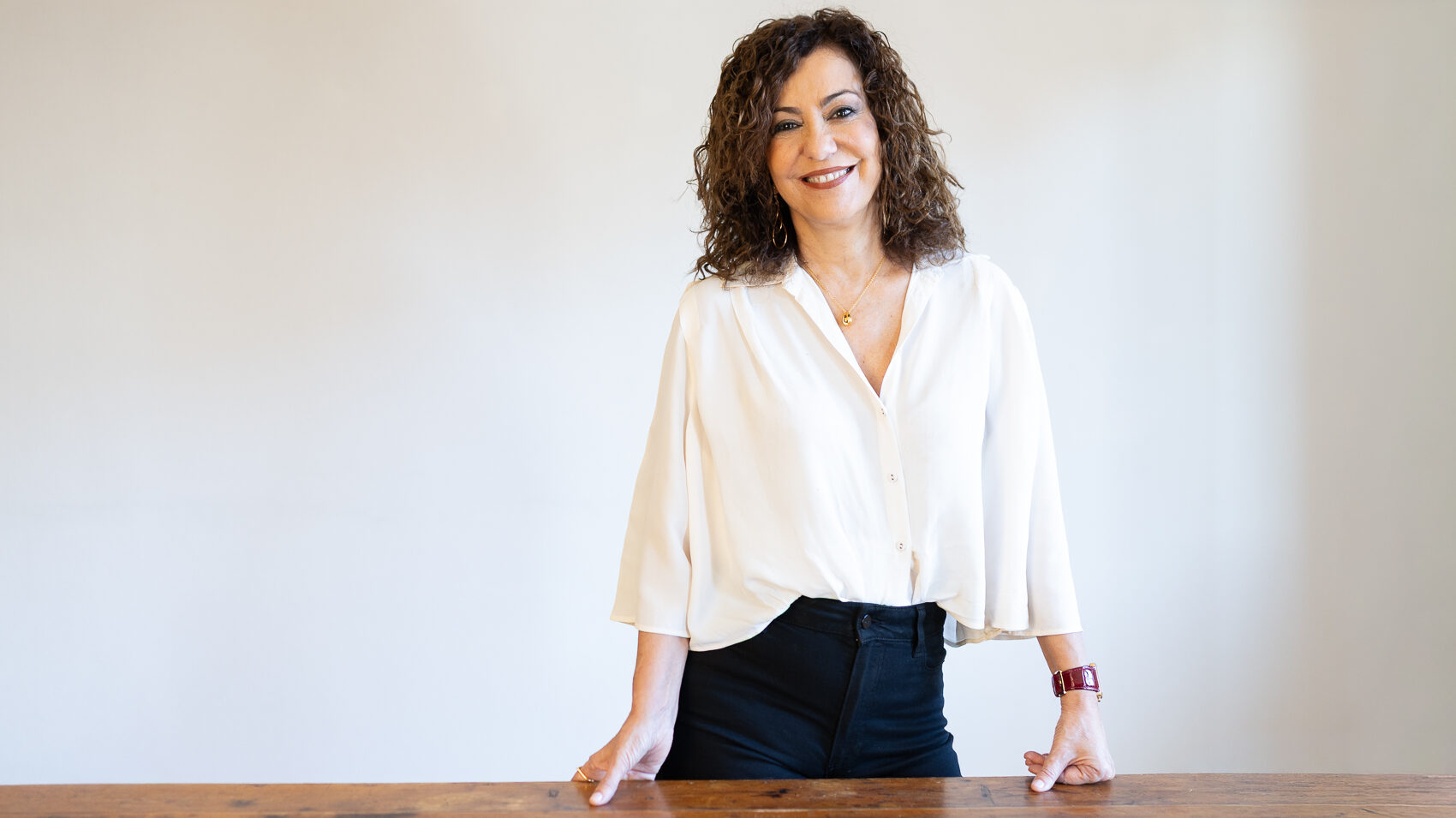
Maria de la Pau Janer (Palma de Mallorca, 1966), who holds a Ph.D. in Catalan Philology from the University of the Balearic Islands (UIB), where she teaches, is one of Mallorca’s distinguished writers who no longer has anything to prove to the literary world. Proud of her roots, she has an extensive literary career (she has worked primarily as a novelist) in both Spanish and Catalan, and has been honored with numerous literary awards, including the Ramon Llull Prize (1999) for Lola, and the Planeta Prize (2005) for Pasiones romanas, making her the only writer from the Balearic Islands to have achieved this distinction.
How does one become a writer?
Ever since I was a child, I’ve been a voracious reader, thanks to the fact that my home had an atmosphere that encouraged reading. My parents were very involved with literature, and for all of us siblings, it was completely natural to have books at home and to have stories read to us. So, as a result of being such an avid reader during my teenage years, I began to write. By the time I was 12, I was already writing stories and reading them to my parents.
At what age did you publish your first book?
I’m actually embarrassed to say this, but the first book I published was a novel I wrote when I was 19, La mirada de ayer, and I submitted it to the Ciutat de Palma Prize. I was a finalist, and a publisher from Valencia wanted to publish it.
Which authors have influenced you the most?
My father, Gabriel Gener Manila, who is a writer and novelist, has had a decisive influence on me, since my siblings and I grew up in an environment that was very conducive to literature from a very young age—he was deeply passionate about reading and writing, and he has been a great role model for me. Besides, I’ve devoured books in spurts. I remember when I was a little girl, my grandmother had every Agatha Christie book, and by the time I was 12, I had already read them all. I discovered novels like Anna Karenina, Tiranc lo Blanc, Madame Bovary, and the Brontë sisters’ novels at a very young age, as well as many poets such as Lorca, Salinas, and Joan Margarit…
You have had an extensive career as a writer. Which genre do you feel most comfortable with?
My world is, above all, the novel. I feel much more comfortable creating the structure of a novel, which is a grander architecture than that of a short story. I’m a novelist through and through, and I’m incapable of writing poetry, because I believe it requires a more concise way of thinking. In contrast, to write a novel, you have to create a fictional world.
Are you working on any literary projects right now?
Yes, I’m finishing up a novel, but since I’m a little superstitious, I can’t say much about the content until it’s completely finished—otherwise it might all go down the drain—but I’m already in the home stretch.
She is the only writer from the Balearic Islands to have won the Planeta Prize (2005), for her novel Pasiones romanas. What did that mean for you and your career?
Just think—three years earlier, I’d already been a finalist with the novel Las mujeres que hay en mí. I went on the Planeta tour and was very lucky because the winner was Alfredo Bryce Echenique, who passed away recently; he was not only a great writer but also an extraordinary character, so we had a lot of fun. That tour was very enriching. In 2005, I won the prize with Pasiones romanas and went on the tour again. I think the Planeta Prize marks a turning point in a writer’s career, and deep down, we’ve all thought about winning it someday. Just look at how many people enter—and if you’re lucky enough to win, it’s great because the promotional campaign organized by the Planeta Group is incredible. It really boosts sales, fosters a closer connection with readers, and increases visibility—and that has a huge impact on you.
Which writer—male or female—would you like to sit down and talk with for hours?
Quite a few. For example, the Italian writer Elena Ferrante, author of the four-book series My Brilliant Friend, which Netflix has turned into a really good series that I’m really enjoying. She writes under a pseudonym, so no one has ever known who she really is. I’d love to sit down and talk with her, have her explain who she is, and discuss her books, which are wonderful.
In addition to writing and teaching, he contributes to various media outlets. How do you view the world of journalism?
I see it as complicated because there’s so much information, so much fake news, so many people who lie brazenly… I didn’t study journalism—I studied philology and literature—but I’ve devoted myself to working extensively in the world of communication because I believe I’m a natural communicator. However, right now, I see things as worse than they were ten years ago. But at the same time, I find it fascinating because so much is happening—it’s all so complex—that if you have a little discernment and try to make sense of it, it’s truly captivating.
We are witnessing massive protests in Europe that are ultimately turning into very violent clashes. Can literature reach places that politics, with its rational arguments, cannot?
I am fully convinced that the power of literature is immense, that it has the potential to transform the world. However, it is a slower process than that of a protest, which always makes more noise and has a greater impact. I think that when it comes to changing people and societies, countries where people read are more civilized. In fact, in Spain, as far as I know, young people are reading quite a bit, but it’s a slow process.
What scares you about this society that doesn’t communicate with one another?
I’m afraid that people won’t listen to each other, that they’ll talk but no one will hear what they’re saying, that we’ll build walls and barriers between us, and that people will become increasingly emotionally isolated—in the sense that you have to build a protective shield to save yourself from many of the things that are happening. It seems a little complicated to me.
She holds a Ph.D. in Catalan Philology and is a tenured professor at the University of the Balearic Islands. How do you view university education on the island?
I think the Public University of the Balearic Islands is pretty good, especially the science programs, which are highly rated, although the humanities programs aren’t as highly rated because they’re of a lower standard. Now there’s also a boom in private universities, which has never happened before, and I think that’s a good thing because it’s a way to spur public universities on. I think the university has to be open to society, to its problems, to what’s going on—it has to be a living, breathing entity—and in my classes, I try very hard to encourage my students’ desire to read, their curiosity about things, about literary topics, and about life.
What aspect of that “real Mallorca” is most evident in his literary work?
The region of El Pla, which continues to preserve the essence of Mallorca because, even though many foreigners have bought homes in the villages of the Pla de Mallorca, my roots are there. My father is from Algaida, and my mother is from Llubí, a small village where I spent many summers and part of my childhood and youth. These are peaceful, serene landscapes that may not have the beauty of the Tramuntana Mountains or the coast, but they are more striking and possess a quieter beauty. The rural and agricultural landscapes of the Pla are so authentic and beautiful that they feature in my work because I grew up among them.
A quiet spot in Mallorca where you can get away to write?
My house in Palma. It’s a very old house—it used to belong to my grandfather—with many stories within its walls and filled with objects I’ve chosen because they remind me of my roots. I need that sense of peace and quiet to write, which is why I mentioned my house, but there are also many places where I could sit on a terrace and write an article or something simpler than a novel.
What does Mallorca smell like?
To me, it smells like so many things: the scent of the earth wet from the late-summer rains, when I’d return at dawn from the Pollença festivities in August and smell that aroma of freshly baked bread in the town—something that no longer happens; the scent of my home when I’d open the gates and feel like I was in a wonderful, safe, and magical place; the scent of the people I’ve loved, of my grandmother; so many stimulating and evocative scents. But sometimes, there are also unpleasant smells—from areas that have been neglected and left dirty by the tourist crowds at the height of August. Nevertheless, the scents that run deepest within me are always very beautiful because I believe that aromas are linked to memory, which is incredibly powerful.