







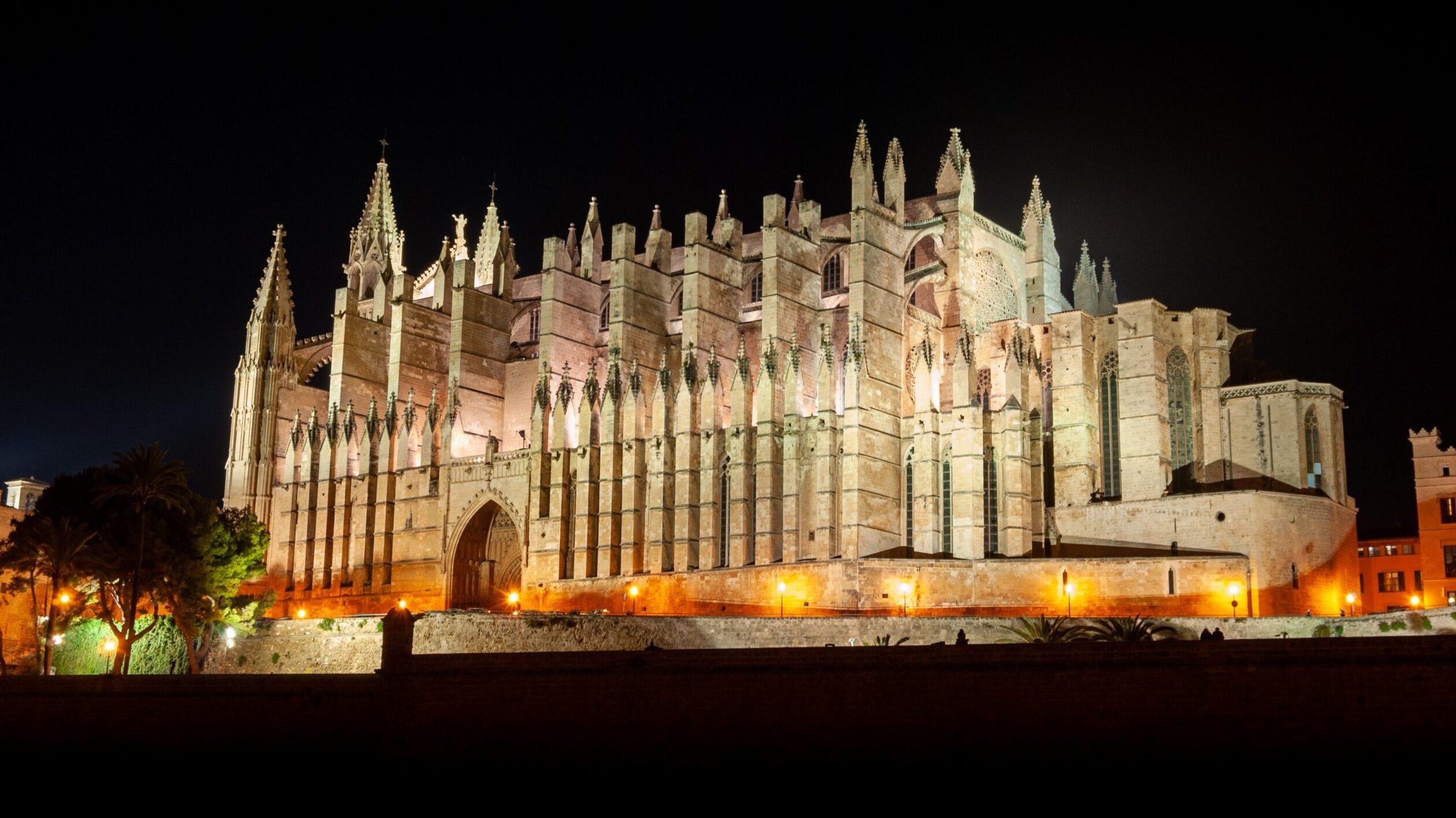
Antoni Gaudí’s influence on the Cathedral of Mallorca can extend beyond the building’s visual and spatial transformation. Research based on historical archives aims to clarify whether the Catalan architect devised a specific strategy to improve sound propagation by reorganizing the choir and incorporating two sound projection openings designed to project the voice and music toward the central nave.
This hypothesis was proposed on Tuesday by Sebastián Escalas, a documentalist at the Seo of Mallorca, who explained that the transfer of the choir from the center of the nave to the presbytery could have been motivated, among other objectives, by the desire to improve the congregation’s acoustic experience. In an era before modern sound amplification systems, architecture played an essential role in transmitting music and voice. According to the research, the choir stalls featured a sound box that would have helped project the singing toward the nave, combining functionality and design in a single element.
The study also focuses on the geometric design of two loudspeakers and the materials used in their construction, including wood, cotton, and fabric. The objective is to determine how these elements might have influenced the acoustic behavior of the church. Escalas believes these devices were likely designed to enhance the projection of the spoken word during sermons. However, he warns that proving their effectiveness requires going beyond documentary interpretation.
“The only way to understand its acoustic behavior is through a geometric reconstruction of the scale based on old photographs,” said the researcher, who stresses that both the reorganization of the choir and the design of the sound-reflecting screens are, for now, working hypotheses.
One of the main obstacles is the lack of a written design by Gaudí for the Cathedral of Mallorca. This lack of documentation makes it difficult to accurately reconstruct the architect’s original intentions. Among the materials that have been preserved are 1902 plans signed by Joan Capó, drawn up at a time when, according to Escalas, it was taken for granted that Gaudí would not produce any sketch for the project.
Gaudí in Mallorca: a project shaped by liturgy
The acoustic research is part of a broader interpretation of Gaudí’s work at La Seu, which requires understanding the dialogue between architecture, light, space, and liturgical function.
Mercè Gambús, a researcher at the University of the Balearic Islands (UIB), maintains that Gaudí must be understood in Mallorca ‘through the prism of the cathedral’. Unlike the architect’s other iconic projects, such as the Sagrada Família or the Church of Colonia Güell, his work at La Seu was conditioned by artistic and liturgical criteria that restricted his scope for action.
Gambús has also studied the spatial and lighting reorganization of the cathedral and maintains that Gaudí’s design can be perceived from the very entrance of the cathedral. This perspective invites us to understand his work not as a series of isolated modifications, but as an integral intervention in the experience of the building.
The next phase of the research will involve reconstructing the cathedral’s floor plan as it was before its current state, with the goal of clarifying how sound was organized and what role Gaudí might have played in this transformation.
Gaudí’s legacy, seen through a new scientific lens
The findings of this research will be presented at the Gaudí International Congress 2026, which will take place from October 22 to 25 at La Pedrera in Barcelona. The conference, specifically dedicated to scientific research on the Catalan architect, will bring together a variety of perspectives on his work and legacy.
The Cathedral of Mallorca, the setting for a decisive project by Gaudí between 1904 and 1915, is a member of the congress’s honorary committee. Its participation highlights the importance of the historical archive and interdisciplinary study for deepening our understanding of one of the architect’s most distinctive projects outside of Catalonia.
Rafel Morro, head of the Mallorca Chapter Archive, will present a paper titled “Documents from the Mallorca Chapter Archive on Antoni Gaudí’s Work at the Cathedral,“ focusing on the value of documentary sources for reconstructing the history of the project.
For his part, Gambús will present ‘Gaudí’s Critical Legacy at the Cathedral of Mallorca and Its Impact on the Monument’s Conservation,‘ a work he describes as a ‘history of history’ of the architect’s intervention at the Cathedral. Escalas will present his conclusions on the acoustic dimension of the project in his article, “Antoni Gaudí’s Renovation of Mallorca Cathedral (1904–1915): Liturgy, Space and Music.”
More than a century after Gaudí’s work on the cathedral, the Seu of Mallorca continues to offer new perspectives on his legacy. Research into the cathedral’s acoustics provides a way to understand the extent to which the architect integrated the auditory experience into his conception of the sacred space – a question that still awaits documentary and scientific confirmation.

