








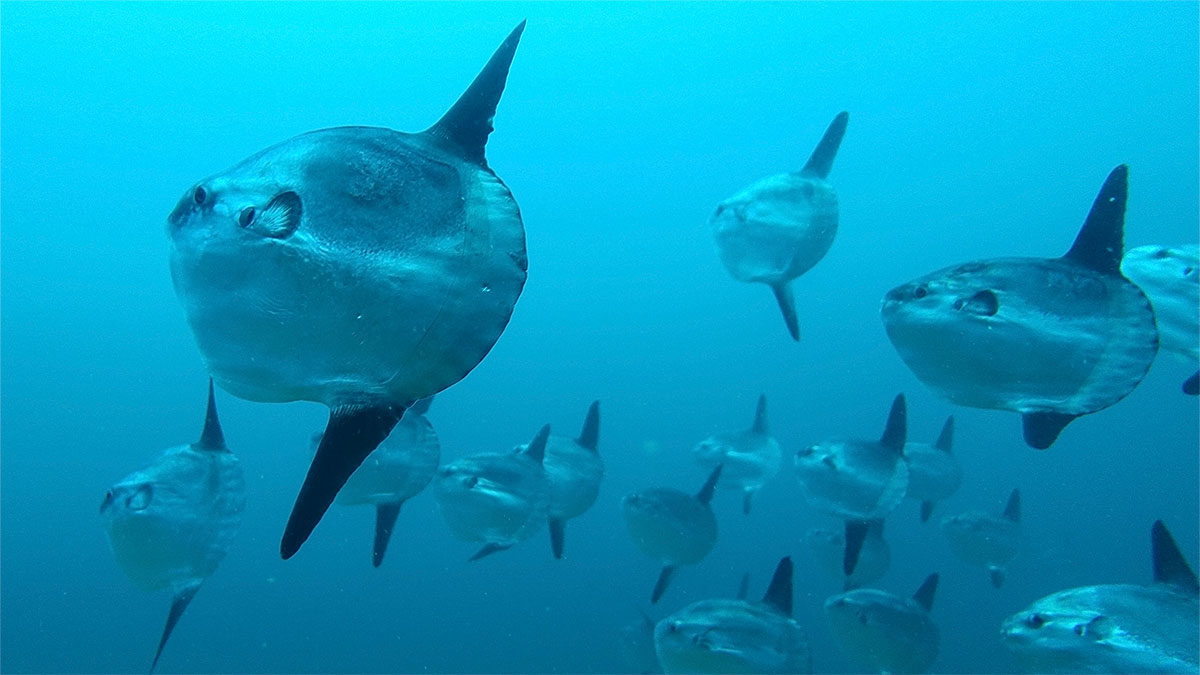
It is one of the most enigmatic and marvelous marine species. It has a dorsal fin and an anal fin that make it look like a crescent moon when it swims with its distinctive style in the open sea, and a flattened body topped by small, curious eyes. Specimens measuring three meters and weighing more than two metric tons have been caught; encountering one while diving is a matter of chance, and its behavior remains a complete mystery.
The sunfish has chosen a wonderful spot on the Basque coast in Spain as its summer refuge: the town of Guetaria, the birthplace of the sailor Juan Sebastián Elcano and the fashion designer Cristóbal Balenciaga, dominated by a former island that became an isthmus in the 16th century. This is the world-famous Ratón, a natural site crowned by a lighthouse that extends several hundred meters beneath the sea, forming a unique marine ecosystem virtually unknown to the general public.
No one knows exactly why, but at the beginning of summer, the moonfish begin to arrive in these cold, murky waters, gathering in groups of tens or hundreds. They take refuge in this corner of the Gipuzkoa coast from the tides of the Cantabrian Sea and have turned it into a sort of spa to rid themselves of parasites. When the sea is calm, they lie on the surface, flapping their fins to call the colony of seagulls that nests nearby, and the seagulls land on them to clean their cartilaginous skin. At other times, they leap nearly a meter out of the water to slap their sides against the surface—again to clean their skin—and keep the jellyfish population that lurks in the area at bay by making them their favorite delicacy.
I’m passionate about scuba diving and have been scuba diving for over 25 years. As soon as I could, I got my driver’s license and my scuba diving certification, having been fascinated by the silent world since I was very young. I’ve dived hundreds of times in the Mediterranean, the Red Sea, and the Indian Ocean, and yet one of the most impressive dives I’ve ever done took place right here in this destination in Gipuzkoa.
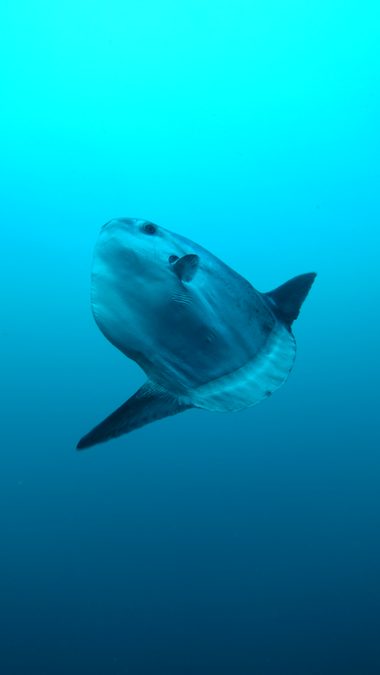
Last August was one of the months with the most moon sightings in Guetaria over the past decade, and photographing them is a fascinating challenge in which local underwater photographers like Mak Iriarte and Gorka Leclercq—with whom I’ve had the privilege of diving—have truly excelled.
With the water very warm at the surface—23 degrees—the constellation of moons disappears into the blue-green depths beyond 20 meters, where the temperature drops sharply to 15. With visibility of barely a handful of meters and the ghostly atmosphere created by the greenish waters of the Cantabrian Sea and its suspended particles, some specimens flit fleetingly across the shallows as if to see what—or who—is disturbing their tranquility in this spectral environment.
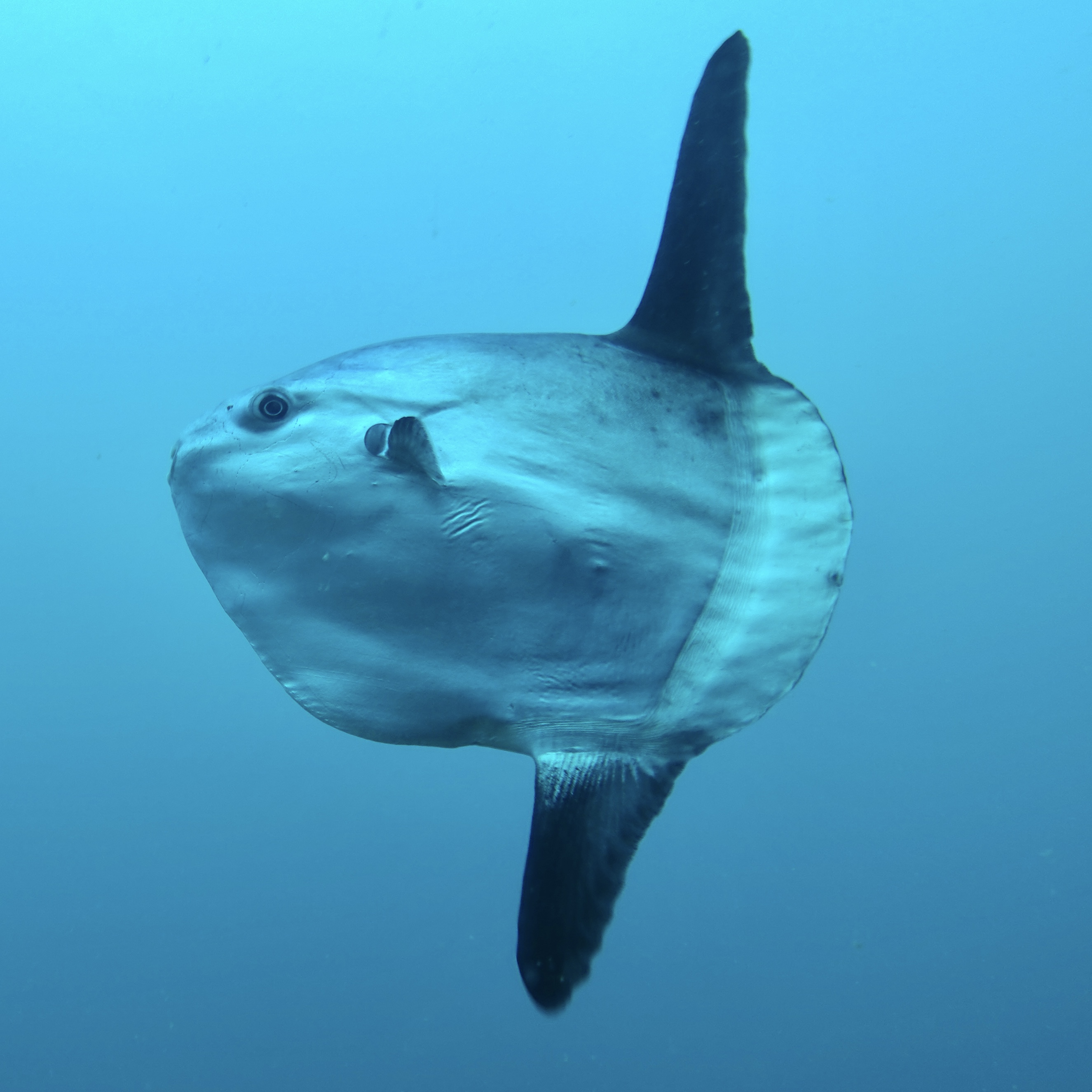
These prehistoric fish approach the diver who dares to wander through their habitat, and with a couple of flaps of their fins, they vanish into the shadows as if they were creatures from another world. Capturing them on camera requires a stillness and patience that I lack, despite my tenacity. The artificial light from the spotlights, which hits them as if they were facing a mirror, causes them to scatter immediately, and one must combine restraint and skill to attract their innate curiosity.
It was during my last dive of the summer when, after encountering a few scattered and elusive specimens, a dark cloud settled over a sandbar and began to move. A couple of my diving buddies and I knelt silently in the dim light, holding our breath, and a school of more than fifty began to approach, parading majestically before us for a minute that felt like an eternity.
They surrounded us, just a few centimeters away; they posed before us as if to reward us for braving the cold; we touched the sky with our cameras; and, like a synchronized swimming team, they vanished with a couple of flaps of their fins into the darkness, gone until who knows when.
@estebanurreiztieta is the deputy director of research at El Mundo and a scuba diver.
This article is part of Issue 8 of Nautik Magazine, which you can find at newsstands or in our online store.
