








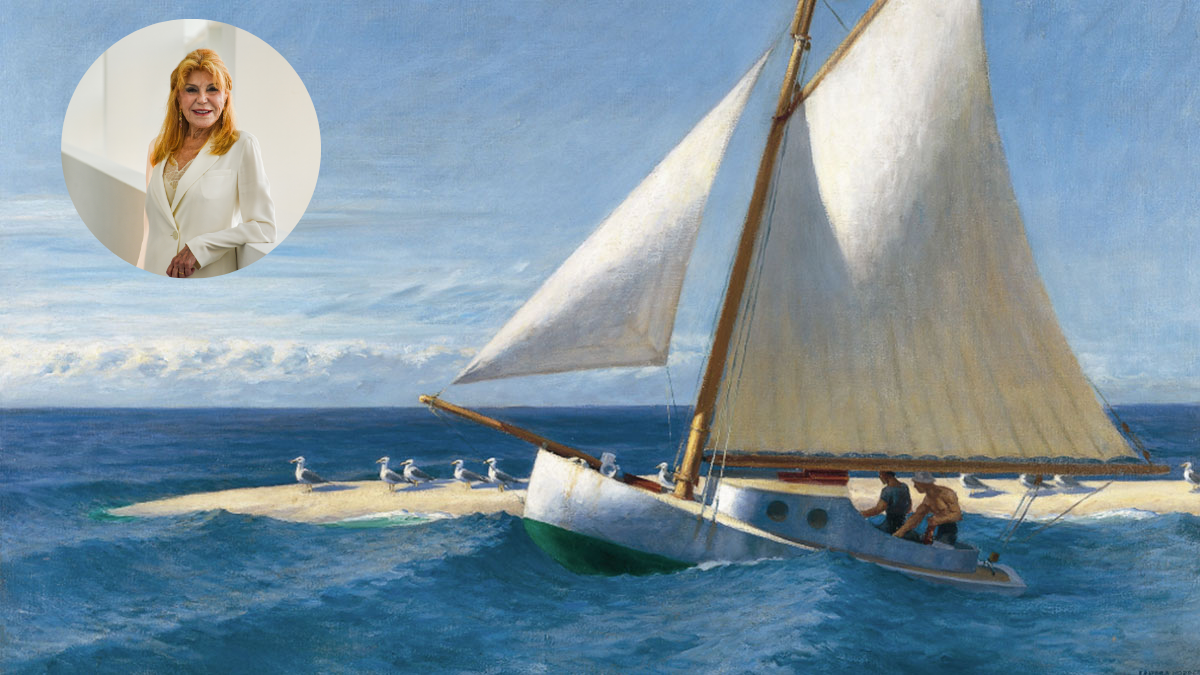
Many Spanish media outlets have reported on a somewhat unexpected piece of news: Baroness Carmen Thyssen is set to auction off one of the jewels of her private collection—the Martha McKeen of Wellfleet—which will go on sale on November 18 at Sotheby’s in New York. The auction house estimates that the sale price will range between $20 million and $30 million (between 17.9 million and 26.8 million euros). What makes this painting so special that it commands such a high price?
When one thinks of Edward Hopper (Nyack, 1882 – New York, 1967), deserted streets, hotel rooms, and solitary figures come to mind. Carmen Cervera’s oil painting breaks with that cliché: it depicts a sailboat under the sun on an August morning in Cape Cod, and that rarity accounts for much of its appeal.
A luminous Hopper, far from urban melancholy
Guillermo Solana, artistic director of the Thyssen-Bornemisza Museum, emphasized in 2015 in *Expansión* that we are so fascinated by Hopper’s depiction of urban desolation (his *Hotel Room*, the museum’s masterpiece, embodies that stereotype) that it’s almost inconceivable he would have painted a sailboat on a radiant summer day. And yet sailing was a passion for him comparable to the one he felt for art: according to Solana, “he was as passionate about sailing as he was about painting—or perhaps even more so.”
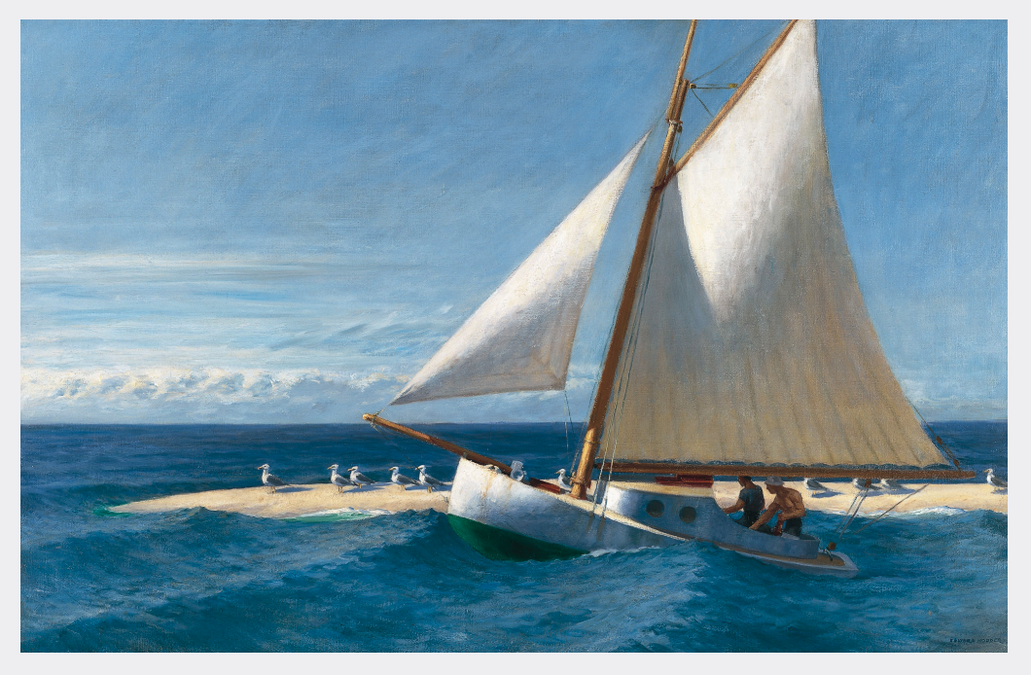
The painting (oil on canvas, 81.5 x 127.5 cm, signed in the lower right corner) is, according to the report from the Carmen Thyssen-Bornemisza Collection, “impressive”: vibrant shades of blue that contrast with the white sails and the sandbar, sunlight that dramatizes the entire composition, and seagulls casting blue shadows. The action appears frozen in time, but Hopper captures, in the words of art historian Gail Levin, the immense power of the sea and man’s momentary harmony with it.
A Painter’s Passion for Ships
As a child in Nyack—a port on the Hudson River that was home to a shipbuilding industry at the time—Hopper drew sailboats, and as a teenager he built a lute. The first painting he sold, *Sailing*, was also the only work he exhibited at the famous 1913 Armory Show in New York. This was followed by seascape oil paintings such as *Long Ripple* (1935), *Swell* (1939), and *Leeward Coast* (1941), of which *The Martha McKeen of Wellfleet* is the successor.
His wife, Josephine Nivison (Jo), had forced him to stop sailing alone because she considered it too dangerous. So Hopper went out with Martha and Reggie McKeen, from Wellfleet—a much younger couple—and this painting and others with nautical themes were born from those voyages. He sailed with them on August 12, 1944, “seeking inspiration as well as pleasure,” as Solana notes, citing Levin’s biography.
A title with sentimental value
The sloop in the painting—a simple little boat with one mast and two sails (a gaff-jib and a jib)—did not exist under that name. When a publisher suggested changing the title, Hopper refused: “The young woman after whom the painting is named has taken us sailing so many times in Wellfleet Harbor that the title has sentimental value for us and also for Martha McKeen.” He added that, as far as he knew, there was no boat by that name: “We named it after our friend.”
Seagulls, a helmsman, and a play about “ideas”
Jo noted that during a visit to Provincetown, where they were studying the seagulls at a fish market on the pier, the birds lined up, all facing away from the wind. That is how they appear on the canvas, forming a decorative frieze. He gave that painting a humorous subtitle: Where the Seagulls Fill Their Bellies. Two men are seated on board, one of them at the helm, and Jo thought it might be Hopper himself. The only surviving preparatory sketch shows that the painter initially envisioned a single figure standing next to the mast.
The painting was a struggle for him. He began it in August 1944, set it aside on September 12 without finishing it, and did not complete it until December, after he had returned to New York. On September 8, according to Solana, he explained to Jo that he was making slow progress because the painting depicted not facts, but ideas.
One of the baroness’s jewels
According to Vanitatis, the 83-year-old baroness is parting with a work that has “sentimental connotations” for a reason that “has nothing to do with her health.” El Español, on the other hand, frames it as part of her plan to convert part of her assets into cash, after renting out her sailboat, the Mata Mua, this summer for 50,000 euros a week.
The work is part of the Carmen Thyssen-Bornemisza Collection with the following provenance: Frank K. M. Rehn Gallery (New York), Harold Harris (Ellenville, New York), Kennedy Galleries (New York), and the Thyssen-Bornemisza Collection (Lugano), where it arrived in 1980. In 2015, *Expansión* cited it as one of the four works by Hopper that were regularly on view at the Thyssen Museum, and that summer it was on loan to the Carmen Thyssen Museum in Málaga for the exhibition *Summer Days: From Sorolla to Hopper*.
The link to register for the auction is as follows: Sothebys.com