








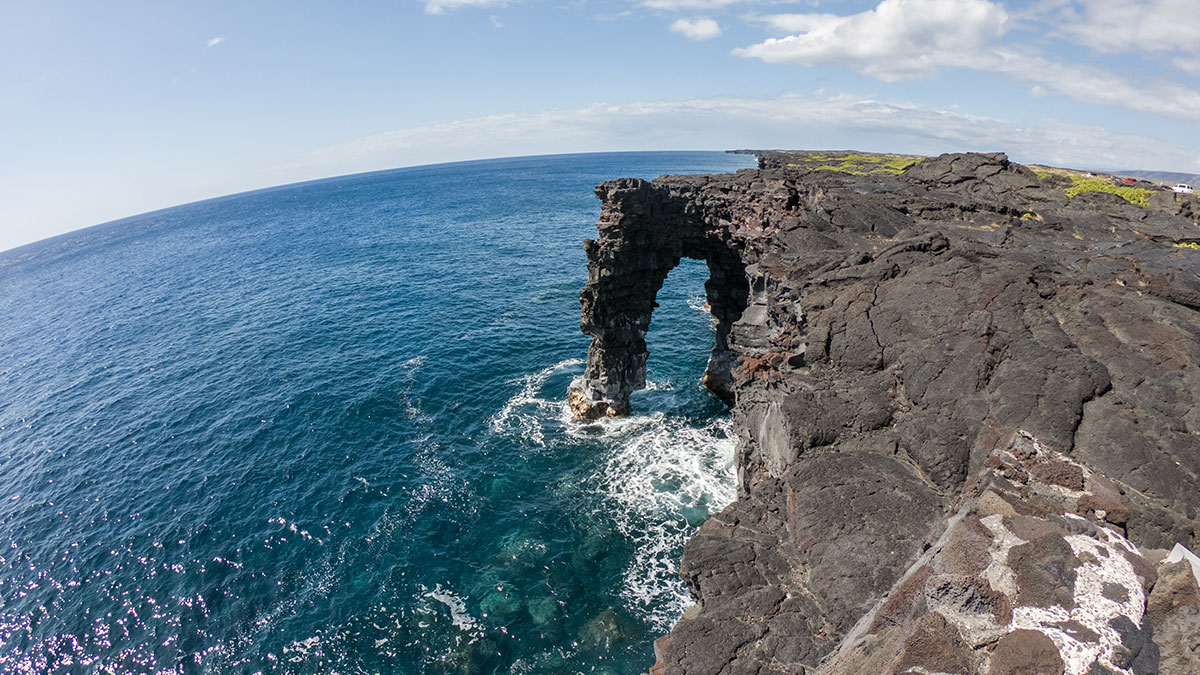
The Hōlei Sea Arch, one of the most photographed landmarks along the Hawaiian coast, has collapsed into the Pacific Ocean. The U.S. National Park Service (NPS) has confirmed the disappearance of this lava rock formation, located in Hawaii Volcanoes National Park on the southern coast of the Big Island.
Standing about 27 meters tall, the arch was still standing on Wednesday, September 23. According to the NPS, it had disappeared by Sunday night, September 27. The exact time of the collapse is unknown, although it may have occurred while the park was closed due to Tropical Storm Nolo. When the park reopened on Monday, September 28, the arch was gone.
“Yes, it’s true. Rest in peace, Hōlei Sea Arch,” the park wrote on Facebook and Instagram, along with before-and-after comparison photos. The message added that the arch was a very special place for many of its visitors.
A Foreseen Ending
The arch was formed about 550 years ago, when an ancient lava flow from one of the island’s volcanoes reached the edge of the cliff and carved out the arch. Located at the end of Chain of Craters Road, it has over time become one of the park’s most visited and photographed destinations.
The NPS notes that instability along the adjacent coastline had been evident for years. Earthquakes caused by the Kīlauea eruption and the collapse of its summit in 2018 damaged the nearby cliffs. In January 2020, the appearance of new cracks led to the closure of the original viewing area, and in March of that year, another viewing area was opened farther from the edge. Months later, heavy waves from Tropical Storm Darby tore a piece of rock from the lower part of the arch.
In 2021, the NPS itself had already warned that the arch would eventually collapse. “This formation is beautiful, but temporary,” the agency noted at the time, adding that other arches will replace it as the cliff recedes inland. The process responsible is differential erosion, whereby softer rocks erode earlier and faster than more resistant ones. It is the same mechanism that shaped the arch more than five centuries ago.
A Call for Prudence
Following the collapse, the park has asked visitors not to approach the edges of the cliff, which drop vertically into a rough sea pounded by waves. According to the NPS, photos are circulating on social media of people who have entered the closed-off area where the arch once stood, posing a serious risk of falling and drowning for both them and rescue teams. The agency insists that closed-off areas must be respected and reminds the public that cliffs can collapse without warning.
The news has sparked thousands of reactions on the park’s social media accounts, where users are sharing memories and photos of the arch. “Nothing and no one lasts forever,” one of them wrote on Facebook.