







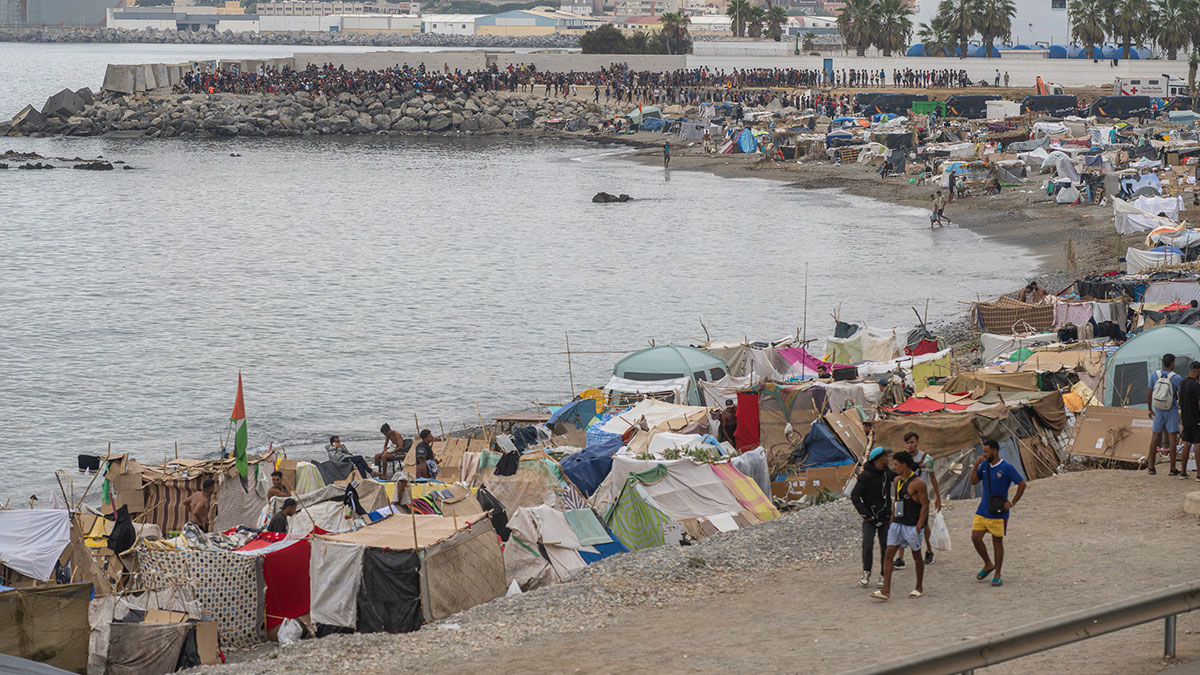
On Tuesday, Magnus Brunner, the European Commissioner for Home Affairs and Migration, called on the plenary session of the European Parliament in Strasbourg, an “urgent solution” to the migration crisis in Ceuta and identified as a priority the “swift” return to Morocco of those who entered irregularly on July 30 and 31 and are not entitled to remain on EU territory.
“A solution must be found as a matter of urgency. Our priority is clear: everyone who entered illegally and has no right to remain must be swiftly returned to Morocco,” the Austrian leader stated during the debate on “hybrid attacks” and the exploitation of migrants in the autonomous city.
Brunner noted that “thousands” of migrants awaiting return remain in Ceuta, including 2,000 unaccompanied minors, which is creating pressure and posing public order challenges in a territory of less than 20 square kilometers. Spanish Interior Minister Fernando Grande-Marlaska, for his part, has cited a different figure: according to Interior Ministry data, more than 90% of those who arrived have already returned within a short period of time.
Brussels Supports Changing European Regulations
On Thursday, Minister Grande-Marlaska and Minister of Inclusion, Social Security, and Migration Elma Saiz conveyed to Brunner the Spanish government’s support for new EU legislative changes that would speed up return and international protection procedures in migration crisis situations such as the one in Ceuta. The request comes after European Commission President Ursula von der Leyen proposed a new European framework for responding to migration emergencies. The proposal has yet to be processed by EU institutions and does not, in and of itself, entail an immediate change in the procedures applied in Ceuta.
Brunner will travel to Madrid this Thursday to meet with Marlaska, Torres, and Saiz, and he acknowledged Morocco’s cooperation on deportations, although he cautioned that there is still “work to be done” to curb irregular departures and combat human trafficking.
The European Parliament Includes Ceuta in the Debate on Hybrid Warfare
At the same time, on Wednesday, the European Parliament incorporated into its position on hybrid warfare an amendment from the People’s Party that condemns the “assault” on the southern border in Ceuta and calls for an independent investigation into its planning, execution, and objectives. People’s Party MEP Nicolás Pascual de la Parte argued that what happened “cannot be reduced to a migration crisis,” but rather constitutes “an attack on Spain’s territorial integrity.” His colleague Juan Ignacio Zoido called for applying the lessons learned on the eastern front against Russia and Belarus to the Mediterranean.
The debate in Strasbourg led to a direct confrontation between the political groups. The president of the Socialists and Democrats, Iratxe García, argued that “Ceuta is Spain, Ceuta is Europe” and called for a response based on solidarity, accusing the right of “manipulating” the crisis and singling out Giorgia Meloni’s Italian government for its positions on Schengen. Dolors Montserrat of the People’s Party described what happened as a “textbook hybrid war” and blamed Pedro Sánchez for failing to react in time.
PNV MEP Oihane Agirregoitia revealed that the Moroccan government sent an email the day before to all MEPs pledging to readmit all affected individuals, including unaccompanied minors, though she called for that pledge to be translated into action. Sumar MEP Estrella Galán denounced that the crisis is being used to “settle scores with progressive Spain” and blamed Morocco, the United States, and Israel.