







I’m going to share an open secret with you: the first edition of the Ocean Race Atlantic 2026 might just be the most interesting thing you hear today. How can I be so sure of this prediction about the appeal of this ocean race? For starters, the 2026 Ocean Race Atlantic is a high-speed, fully crewed transatlantic sprint that runs from the waters off New York to the spiritual home of the most daring round-the-world sailing: Lorient, France.
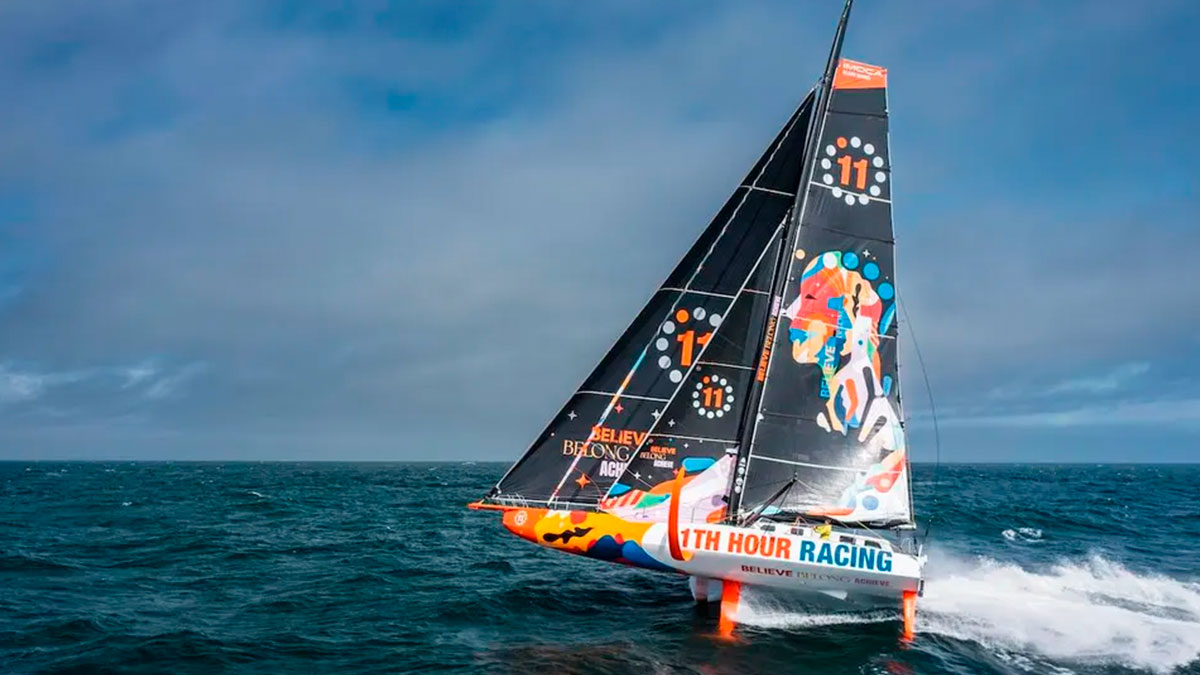
Second, have you seen the photo of the hydrofoil monohull that literally leaps at the top of this article? That’s the latest version of a foiling IMOCA 60, the class of boat that will compete this week as six international teams (each consisting of two women and two men) cross the Atlantic. Following these passionate crews as they push their boats to the limit is both inspiring and addictive.
The IMOCA 60 foiling class is extremely appealing, but that’s nothing new. What fascinates me about the Ocean Race Atlantic 2026 is how the race is organized. Because in addition to being a world-class event that has brought together some of the best ocean sailors in New York, the Ocean Race Atlantic 2026 has worked closely with 11th Hour Racing to advance marine science and outreach, demonstrate sustainable excellence in major events, and even ask elite teams to collect critical climate data as they cross the Atlantic. Anyone who has seen the hustle and bustle of the ocean racing teams at Brooklyn Bridge Marina this summer can attest to the impact the race has had on the city. But… there’s one detail.

The fleet will sail past the Statue of Liberty on Wednesday, September 2, but the actual race won’t begin until the boats cross a virtual starting line located about 145 miles from the mouth of New York Harbor, because it turns out that Atlantic right whales and other marine mammals, as well as large fish, enjoy spending the summer—and feeding—in that area.
As one might expect, nothing is more important to veteran race director Phil Lawrence, and for Damian Foxall (the experienced ocean sailor who is also the co-founder of Foxall Munro, a sustainability consulting firm specializing in the sports and maritime sectors) than doing everything possible to eliminate the risk of collision with the marine life they are trying to protect.
So I spoke with both of them recently to find out why the team behind the 2026 Ocean Race Atlantic—and The Ocean Race in general—goes to such great lengths to do the right thing for the planet while organizing exciting events around the world.

“I’ve always been fascinated by the mystery and adventure of ocean racing,” I tell Phil. “And I love how The Ocean Race Atlantic 2026 combines science and sailing. How did this come about?”
“I’ve been leading The Ocean Race since 2016, when it was still called the Volvo Ocean Race,” replies Phil Lawrence. “Back then, the boats were fairly conventional and not as fast as they are today. We established some biodiversity exclusion zones. There were areas—especially off the northeast coast of the United States—where we knew right whales were present, so we closed those off. But nothing comparable to the scale we’re dealing with now.”
“After the race ended in 2018, we switched to using high-speed IMOCA 60 foiling monohulls,” he continues. “As you know, those boats rise up on their foils. They can exceed 30 knots, and the risk of collision is high, so we needed to mitigate it. We began working with Damian and his team at 11th Hour to see how we could develop more knowledge, more information, and better risk management in this area.”
“It’s not just us; it’s the crews, too,” he explains. “In other words, we share the same goal: to protect marine wildlife, but also to protect the crews and the ships. Because the ships are so fast that colliding with a whale would obviously be a terrible blow to the animal, but there’s also a huge risk of serious damage to the ship and injury to the crew.”

“So we are deeply committed to mitigating this risk, both as an event and in collaboration with all the teams. Obviously, we still want to be able to hold our events. For the 2023 regatta, we implemented many more mitigation measures. For example, in South Africa we changed the start because there was a whale sighting that very morning, before we were set to begin the race. We added many more exclusion zones, as well as active exclusion zones off the coast of the United States. And since then, we’ve organized the Round Europe Race. Once again, we worked with Damian’s team in much greater detail, and they helped us design the course. And we didn’t have a single collision in that race. I’m not saying it was solely due to the mitigation measures, but it’s an extraordinary result.”
“We didn’t have a single incident—not even a minor one—during that race,” he adds. “So something was working there, and the mitigation measures had the desired effect. The teams are fully committed to this. They report their sightings, use the Whale Alert app, and are fully engaged. Before each leg of that race, we hold a briefing for the teams so they understand the risks they face, how we’re mitigating them, and what they should be on the lookout for. We’ve gone even further to mitigate risk with high-precision exclusion zones and by moving the virtual starting line farther offshore for this race. The risk won’t disappear entirely. There will still be some risk. But it will be greatly mitigated to ensure that this is a safe event.”

260417 – BI – Will Harris – Francesca Clapcich / 11th Hour – Julien Champolion / polaRYSE – 11th Hour Racing Team. PHOTO: Julien Champolion – polaRYSE / 11th Hour Racing
“And Damian,” I ask, “how does that work in practice? How do you help mitigate the risk of a collision with a whale that you’re actually trying to protect?” “Well,” he replies, taking a deep breath, “we started by forming the Marine Mammal Advisory Group to provide a platform and a common strategy under which to promote biodiversity protection and find solutions to collisions in the maritime sector. The strategy consists of obtaining and sharing the most recent and highest-quality scientific information, which can be used for route planning, establishing exclusion zones, and conducting risk assessments, in order to define appropriate actions to mitigate those risks. We also rely on ‘citizen science’ from crews, who report sightings of any unmapped hazards at sea and immediately share them with vessels in the area. We use all this information to determine appropriate technical solutions and for outreach, such as regular informational sessions with boat captains. And then there’s the final piece, which I see as ‘pairing,’ where we put all the risk-mitigation resources we have from the nautical sector at the service of the scientific community.”
For all these reasons, he adds: “This allows us to adapt to the most recent data as the start date approaches. And it gives Phil and the regatta’s organizing team the information they need to define an overall strategy, a route, and to mark the exclusion zones.” We’ve also worked with the NYDC team, the New York Department of Environmental Conservation, and we coordinate with NOAA, which maps all kinds of sightings, including whale sharks, basking sharks, sunfish, as well as whales and dolphins. “Each species is a cause for significant concern if it’s found at the surface.”
“We’re deeply committed to protecting the ocean and its wildlife,” Phil adds as we’re about to say goodbye. “Our motto is ‘The ocean is our racetrack,’ and we’re deeply committed to that in every way. We want to do the right thing. And we want people to see that we’re doing the right thing. But the truth is, quite simply, that we want to protect our sailors, our assets, and marine mammals. It’s just common sense.”
I couldn’t agree more.